Total Democratic Votes for House of Representatives 2018
Pew Inquiry Center conducted this report to understand how Americans voted in 2022 and how their turnout and vote choices differed from 2016. For this analysis, we surveyed U.S. adults online and verified their turnout in the two elections using commercial voter files that aggregate official state turnout records.
Nosotros surveyed 10,640 U.S. adults online in November 2022 and 4,183 adults in November and December 2016. Anybody who took function is a member of Pew Research Eye'due south American Trends Panel (ATP), an online survey console recruited through national, random sampling of phone numbers or, since 2018, residential addresses. This way most all U.Due south. adults have a take a chance of choice. The surveys are weighted to be representative of the U.S. adult population by gender, race, ethnicity, partisan amalgamation, didactics and many other characteristics. Read more near the ATP's methodology. Verification of voter turnout involved matching the panelists to 2 or more commercial voter files. Panelists for whom a tape of voting was located are considered validated voters; all others are presumed not to have voted.
Here are the questions used for this report and its methodology.
Compared with Hillary Clinton'south 2-betoken popular vote advantage over Donald Trump in the 2022 presidential election, the Autonomous Political party expanded its margin over the Republican Political party to 9 points in votes cast for the U.S. House of Representatives in 2018, a proceeds of seven percentage points. This increased support was sufficient for the Democratic Party to gain the majority in the House with a net pickup of 41 seats. Voter turnout every bit a share of the eligible population was 49%, the highest for a midterm election in 100 years. A new analysis of verified voters from Pew Research Middle's American Trends Panel examines what 2022 voters and nonvoters did in the 2022 midterm elections and offers a detailed portrait of the demographic composition and vote choices of the 2022 electorate. Information technology provides an update and comparison with findings from our study of the 2022 electorate.
Compared with how Clinton fared in 2016, Democratic candidates for Congress in 2022 made gains from several sources. Amongst Americans who voted in both elections, Clinton's 2022 voters supported Democrats in 2022 at a slightly college rate than Trump'south voters supported Republican candidates. Slightly more of Clinton's than Trump's voters turned out to vote in 2018. In combination, party loyalty, defection and turnout differences among 2022 voters accounted for a little less than half of the Democratic gains over Clinton's two-point margin.
Nonvoters in 2022 who turned out in 2022 voted heavily for Autonomous candidates, bookkeeping for about half of the Democratic gains. Additionally, a pocket-size share of the gains came from people who voted for third-party candidates in 2016; they favored Autonomous candidates over Republican candidates in 2022 by a narrow margin.
Voting patterns in 2022 reflected a great bargain of continuity with 2016, though Democratic candidates in 2022 did better among a few groups, notably men, young people and secular voters. Voting patterns among several other large groups changed less, including Black voters, voters ages 65 and older, Protestants, regular churchgoers and women.
Given their relatively lower turnout, midterm elections are not necessarily predictive of what will happen in the next presidential election, when many more American voters will take office.
This analysis is based on interviews with 10,640 members of Pew Inquiry Center'south American Trends Console conducted Nov. 7-16, 2018, shortly after the full general election. It also draws on interviews conducted among three,770 of the panelists from Nov. 29 to Dec. 12, 2016, after the general ballot that yr and interviews conducted Aug. 20 to Oct. 28, 2022 amongst all members of the console at that time. Researchers attempted to match the panelists to two different commercial voter files that contain official records of voter registration and turnout for 2022 and 2018. For the panelists interviewed in 2016, their 2022 vote history is based on verification with three additional commercial voter files, every bit described in an earlier written report. (For more details, see "Methodology.") This process of verifying voter turnout helps to correct for the tendency of some people to overreport voting and is generally regarded as providing a more accurate picture of the electorate.
Where the 2022 Democratic reward came from: 2022 nonvoters, higher turnout by Clinton voters, and vote switching
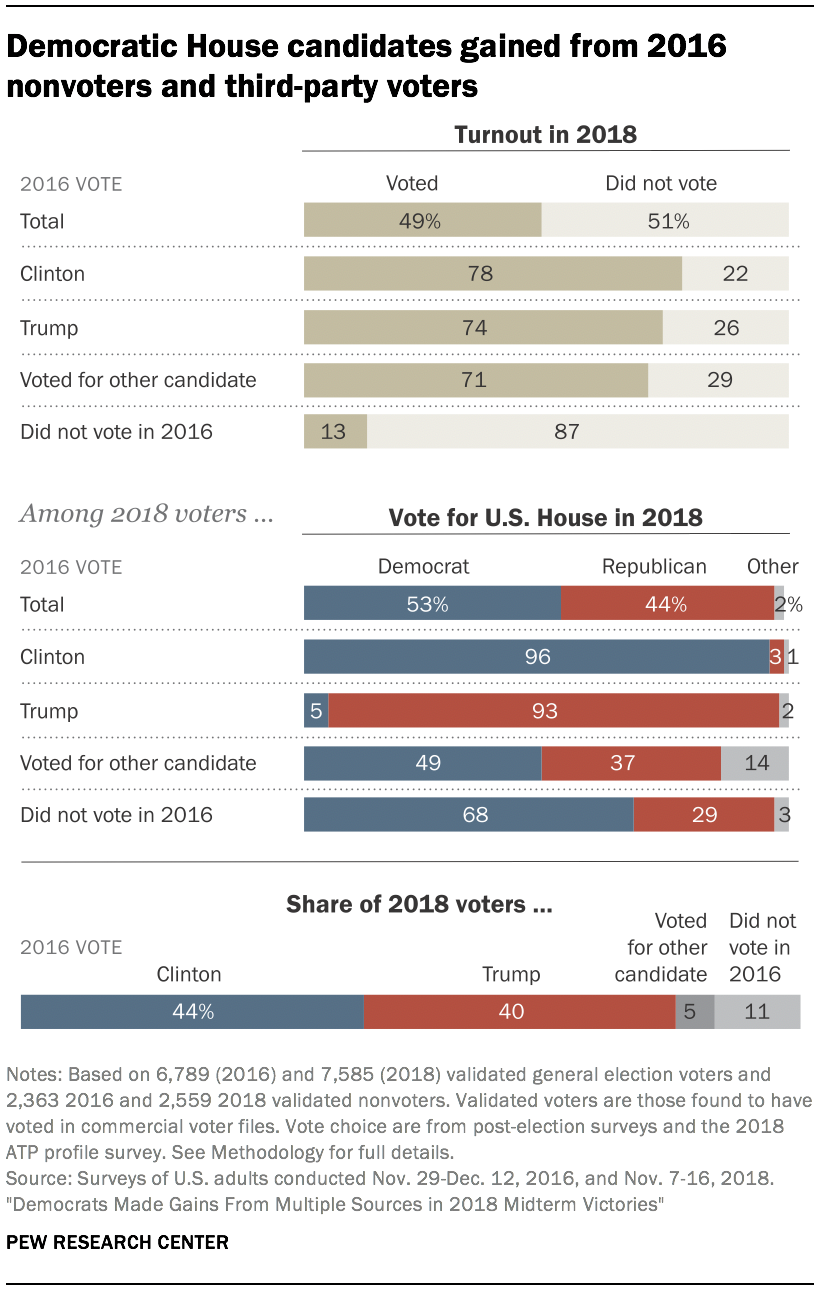 Midterm elections consistently feel lower turnout than presidential elections. Yet while the 2022 turnout of 49% did not match turnout in the 2022 presidential election (59%), it was far college than usual. Midway through President Trump's outset term in office, both Democrats and Republicans were energized. A big bulk of people who voted in 2022 (76%) also voted in 2018. But somewhat more of Clinton's 2022 voters (78%) than Trump'southward 2022 voters (74%) turned out in 2018. Overwhelming majorities of both Trump'due south and Clinton's 2022 voters remained loyal to their respective parties in their 2022 U.South. Firm vote, though Clinton'due south 2022 voters who turned out in 2022 were slightly more than loyal to Democratic 2022 candidates (96%) than Trump's 2022 voters were to 2022 GOP candidates (93%). Amongst the share who voted for someone other than Trump or Clinton in 2016, 71% voted in 2018. These voters favored Democratic candidates over Republican candidates by a margin of 49% to 37%.
Voters in 2022 who did not vote in 2022 were a small group (about 11% of all 2022 voters) but an of import part of why the Democratic Party fabricated gains. Amidst the 2022 nonvoters who voted in 2018, Democratic House candidates led Republican House candidates by a more than a two-to-one (68% to 29%) margin.
Of everyone eligible by citizenship and age to vote in 2018, 44% voted in both the 2022 and 2022 elections; 36% voted in neither; xiv% were drop-off voters (voting in 2022 but not in 2018) and a small share (6%) were new voters – voting in 2022 but non in 2016.
Few defections from party affiliation
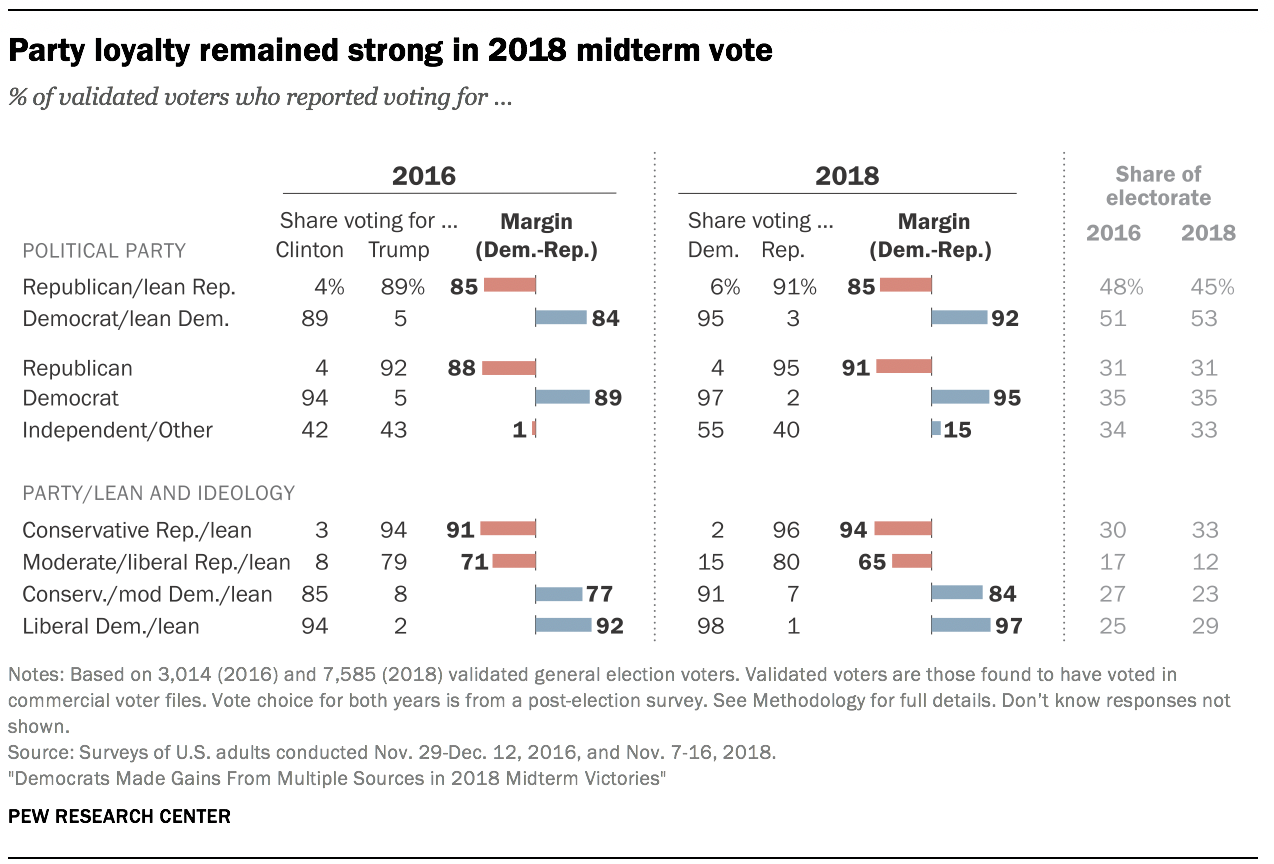
As they did in 2016, Republicans and Democrats voted nigh unanimously for House candidates of their ain party in 2018. Among those who do not initially place with either party (including leaners, members of 3rd parties and "pure" independents), Democratic candidates picked upwards thirteen percentage points of support in 2022 over Clinton's levels. Democratic candidates also made gains among Republicans and leaners who describe themselves as moderate or liberal (from 8% for Clinton to 15% for Democratic Firm candidates).
Democrats did better in 2022 than 2022 among men, young voters
Among most groups, voting patterns in 2022 were generally similar to those in 2016, albeit with nearly reflecting somewhat greater back up for Democratic candidates for the U.S. Firm compared with Hillary Clinton. Men, young people and secular voters were notably more supportive of Democratic candidates in 2022 than these groups had been in 2016.
Democratic gains among men resulted in some narrowing of the gender gap. In the 2022 election, Donald Trump won men by 11 points (52% to 41%) and Hillary Clinton won women by 15 (54% to 39%), for a difference of 26 points. In 2018, women supported Democratic candidates by a similar margin (18 points, 58% to 40%) only the GOP reward among men vanished (fifty% voted Democratic, 48% Republican). Trump carried White men past 30 points in 2022 (62% to 32%), a Republican advantage that shrank to simply 12 points in 2022 (55% to 43%).
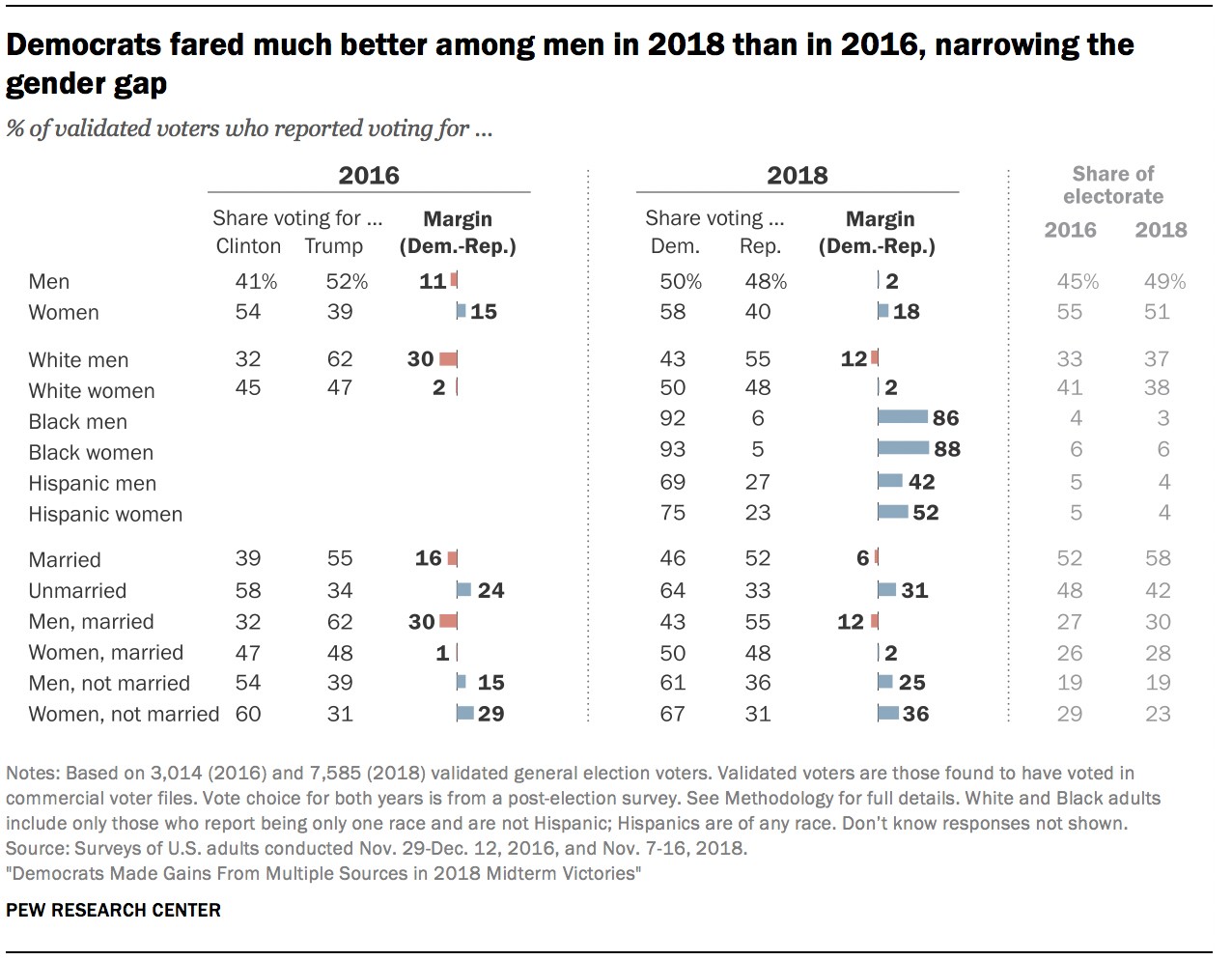
Much as the gender gap shrank from 2022 to 2018, so did the marriage gap. Married voters in 2022 voted for Trump past a 55% to 39% margin but supported GOP Firm candidates in 2022 by merely a half dozen-point margin, 52% to 46%. Unmarried voters were strongly Democratic in both years (58% to 34% for Clinton in 2022 and 64% to 33% for Democratic House candidates in 2018). Much of the decline in the matrimony gap came from men. Trump won married men by a 30-point margin in 2016, but this group backed GOP House candidates by 12 points in 2018. Married women were evenly divided between the parties in both elections. Amidst single voters, women were more than supportive of Democratic candidates in 2022 than they had been of Hillary Clinton in 2016.
Young voters ages 18-29 were solid supporters of Clinton in 2016, simply as a grouping were even more Democratic in 2018. In 2016, voters ages 18-29 voted for Clinton over Trump by a 58% to 28% margin, with xiv% casting votes for third political party candidates. In 2018, this group's votes went 72% for Democratic candidates and 23% for Republican candidates. Immature voters, yet, were significantly underrepresented in the electorate due to depression turnout (every bit they usually are). In 2018, they made up xi% of all voters, significantly below their 21% share of the voting eligible population. Withal, 37% of young voters in 2022 had not voted in the 2022 ballot, a far higher share than in whatever other historic period grouping.
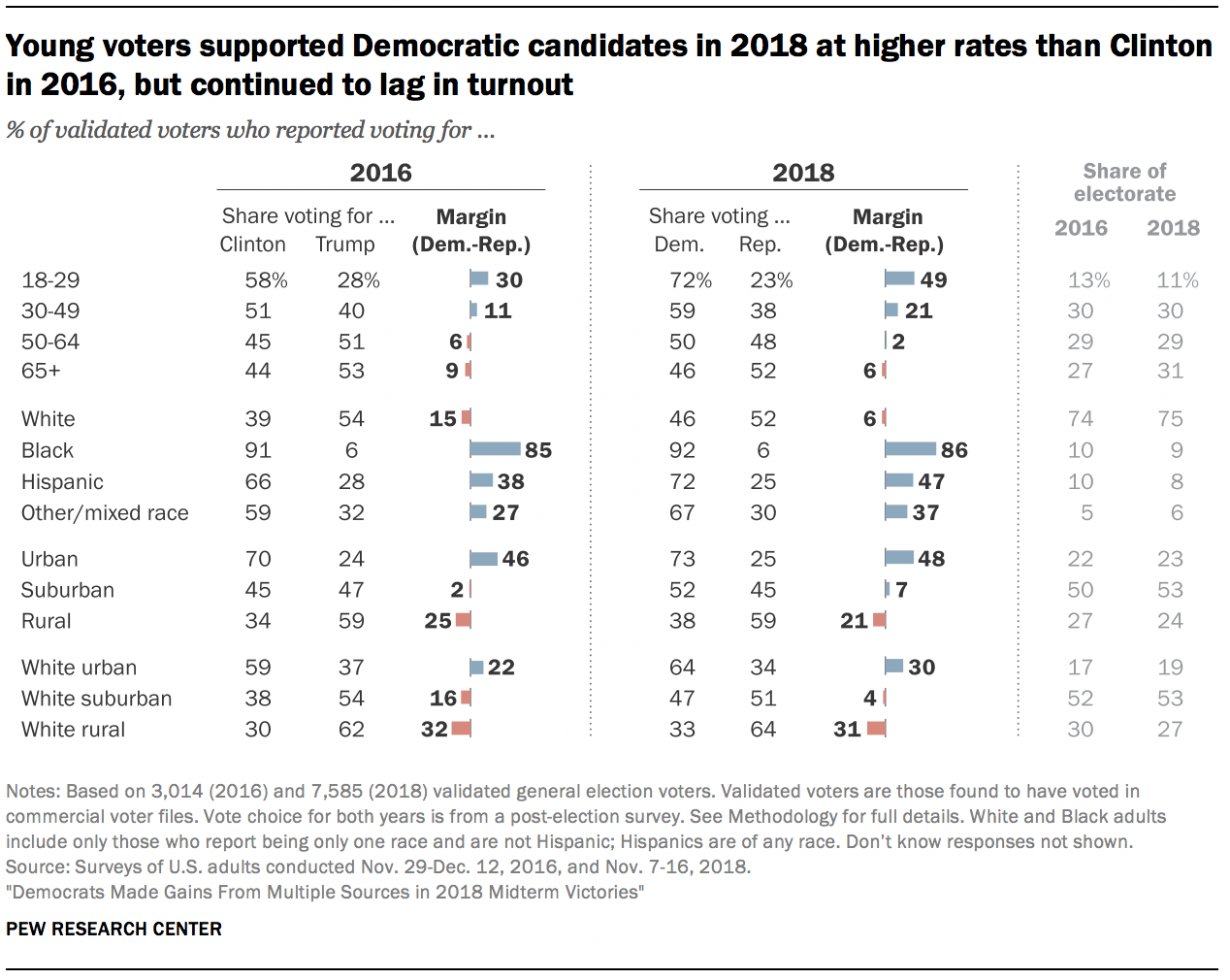
Past contrast, older voters continued to exist the Republican Party's most loyal age group. Trump carried voters ages 65 and older by a 9-point margin in 2016; Republican candidates for the House won this group by half-dozen points in 2022 (52% to 46%). Older voters were near one-third of all voters in 2022 (31%), about three times the share of those ages eighteen-29, despite making up almost the same overall share of the voting eligible population.
Support for Republican candidates among Blackness voters in 2022 was minimal (92% Autonomous vs. vi% Republican in 2018, like to the 91% to 6% margin for Clinton in 2016). Republicans had more support among Hispanic than Black voters, but there were however lopsided majorities for Autonomous candidates (72% vs. 25% in 2022 and 66% for Clinton and 28% for Trump in 2016). There were too few Asian American voters in the sample to yield a reliable judge, but among Asian and other voters of color collectively the 2022 vote was 67% Democratic and 30% Republican. White voters backed GOP candidates over Democrats by 6 points in 2022 (52% to 46%), though this represents a narrowing of Trump's 15-betoken margin over Clinton among White voters.
Geography remained a strong correlate of vote choice in 2018, with urban voters breaking Autonomous by nigh a three-to-one margin (73% to 25%), similar to their split in 2022 (70% Clinton, 24% Trump). Republicans had about a two-to-one reward over the Democrats with rural voters in both presidential voting and in 2018. Meanwhile, the Democrats made gains amid suburban voters. While Trump and Clinton had roughly divided the suburban vote in 2022 down the middle (47% Trump, 45% Clinton), Democratic House candidates won the suburban vote past 7 per centum points two years afterward (52% to 45%).
Voters of color generally voted Democratic regardless of where they lived, though Republican candidates received 37% of the votes of suburban Hispanics and 12% support among rural Blackness voters. White urban voters supported Democratic candidates by a roughly two-to-i margin (64% to 34%) while rural White adults were a almost mirror image (64% Republican, 33% Democratic). Suburban White voters, who favored Trump by xvi points in 2016, were more divided in 2022 (51% Republican, 47% Democratic).
Already a stiff Democratic grouping, those unaffiliated with a religious tradition became more so
In 2018, voters were highly politically polarized by religious affiliation and attendance at worship services, as they have been for many years in the U.S. Solid majorities of Protestants supported Republican candidates in 2018, while Catholics were more divided and the less religious were strongly Democratic in their votes.
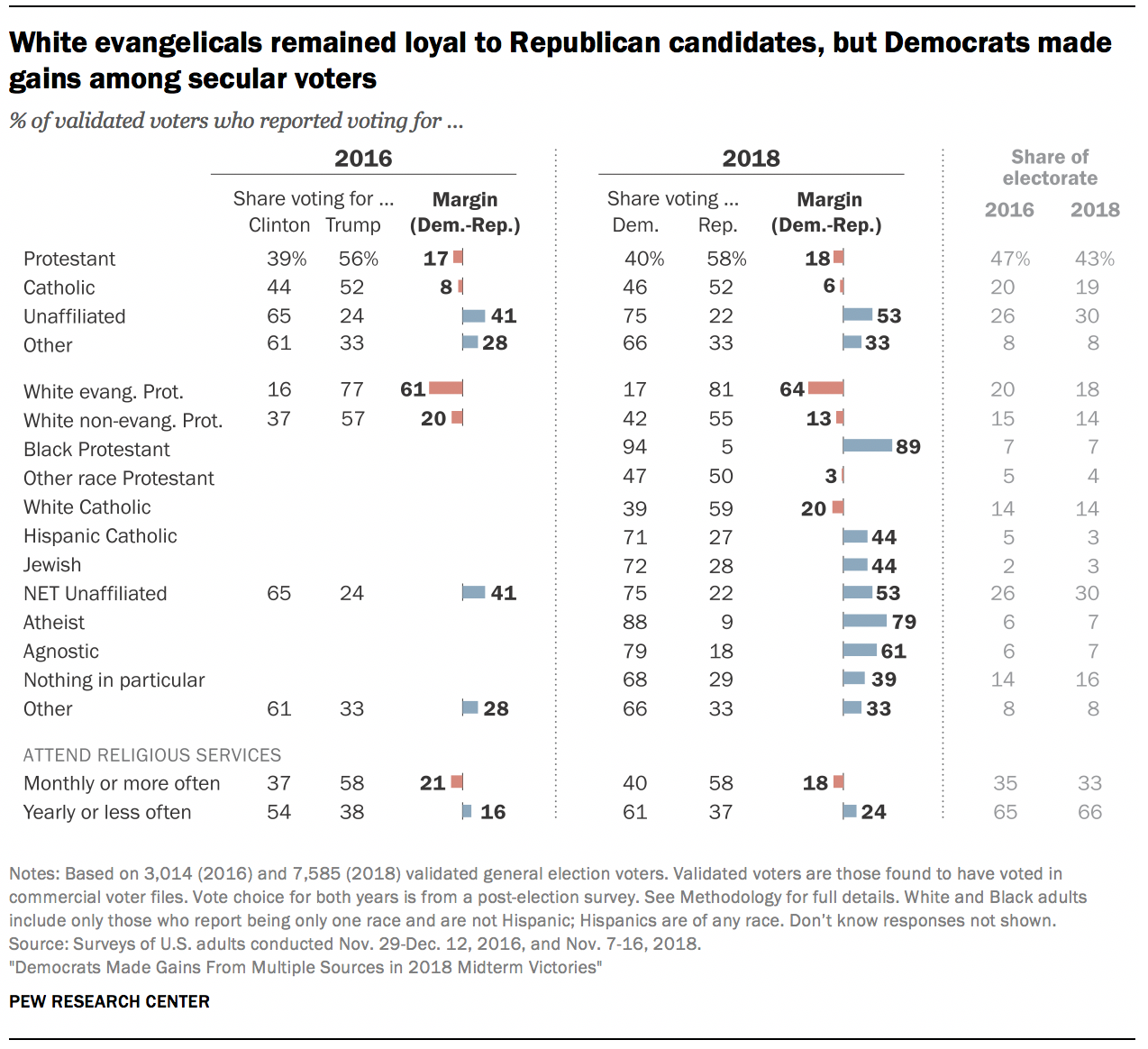
The Republican Party's most supportive demographic group (other than voters who identify as Republican or who are conservative) were White evangelical Protestants (81% voted Republican and 17% voted Democratic). This margin was very similar to 2022 (77% Trump vs. 16% Clinton). A sizable majority of White Catholics also supported Republicans (59% to 39%), with White non-evangelical Protestants shut behind (55% to 42%).
Unaffiliated voters – and especially atheists and agnostics – were fifty-fifty more than supportive of Autonomous candidates in 2022 than they had been of Hillary Clinton, with at to the lowest degree some of the change coming from those who had supported Gary Johnson or Jill Stein in 2016. The margins among voters who describe their religious affiliation as "cypher in particular" were fairly similar in 2022 and 2018. Atheists (7% of voters in 2018) supported Democratic candidates by an overwhelming 88% to 9% margin, rivaling Black back up for the Democrats. Agnostics (also 7% of voters) were not far backside, supporting Democratic candidates by a 79% to 18% margin.
The solid back up for Democratic candidates among the unaffiliated is also reflected in voting patterns past attendance at worship services. Among those who attend a few times a year or less often, 61% voted Democratic and 37% voted Republican. In 2016, this grouping voted 54% to 38% for Clinton. By contrast, voters who attend services monthly or more often voted 58% to 40% Republican in 2018. Two years earlier, they voted for Trump past a 58% to 37% margin.
Democrats made modest gains in 2022 amid non-higher White voters
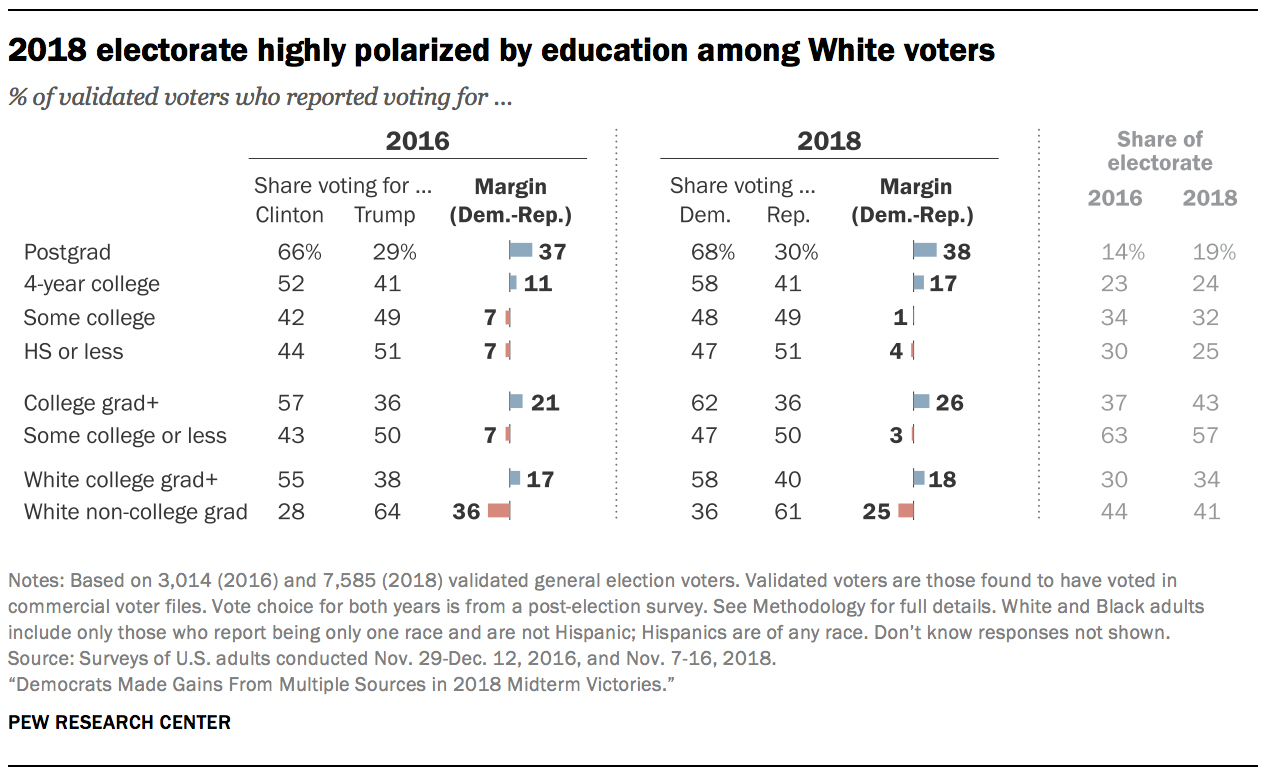
Perhaps the most important political tendency reflected in the 2022 issue was the connected move of working-grade White voters toward the GOP. Hillary Clinton lost White voters who did not have a college degree by a wide 36 percentage points (64% for Trump vs. 28% for Clinton). Just in 2018, Democratic candidates managed to narrow the gap somewhat, losing this group past 61% to 36%, a 25-betoken margin.
At the aforementioned time, the Democratic Political party maintained a wide margin among college-educated White adults. In 2016, Democrats won this group by 17 points (55% to 38%) and in 2022 by a nigh identical 18-point margin (58% to xl%).
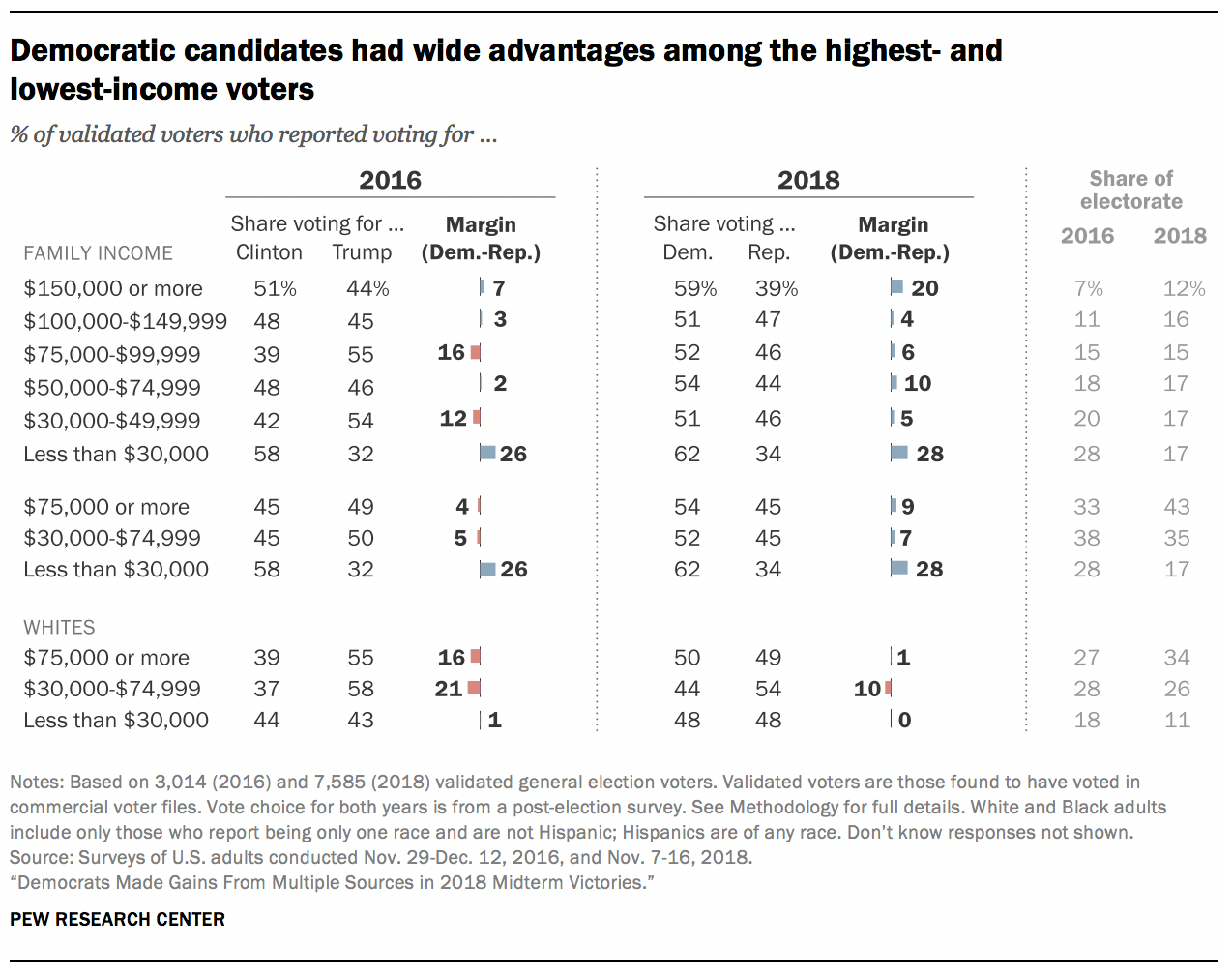
Democratic candidates in 2022 did well among both the highest- and lowest- income voters. Voters reporting annual family unit incomes of $150,000 or higher voted for Democratic candidates by a 59% to 39% margin. At the other extreme, those with incomes below $thirty,000 voted 62% to 34% Democratic. Even among White depression-income voters, Democratic and Republican candidates battled to a tie (48% each). Among White voters with incomes between $30,000 and $74,999, Republican candidates had a 54% to 44% bulk.
The parties' coalitions, 2022 vs. 2016
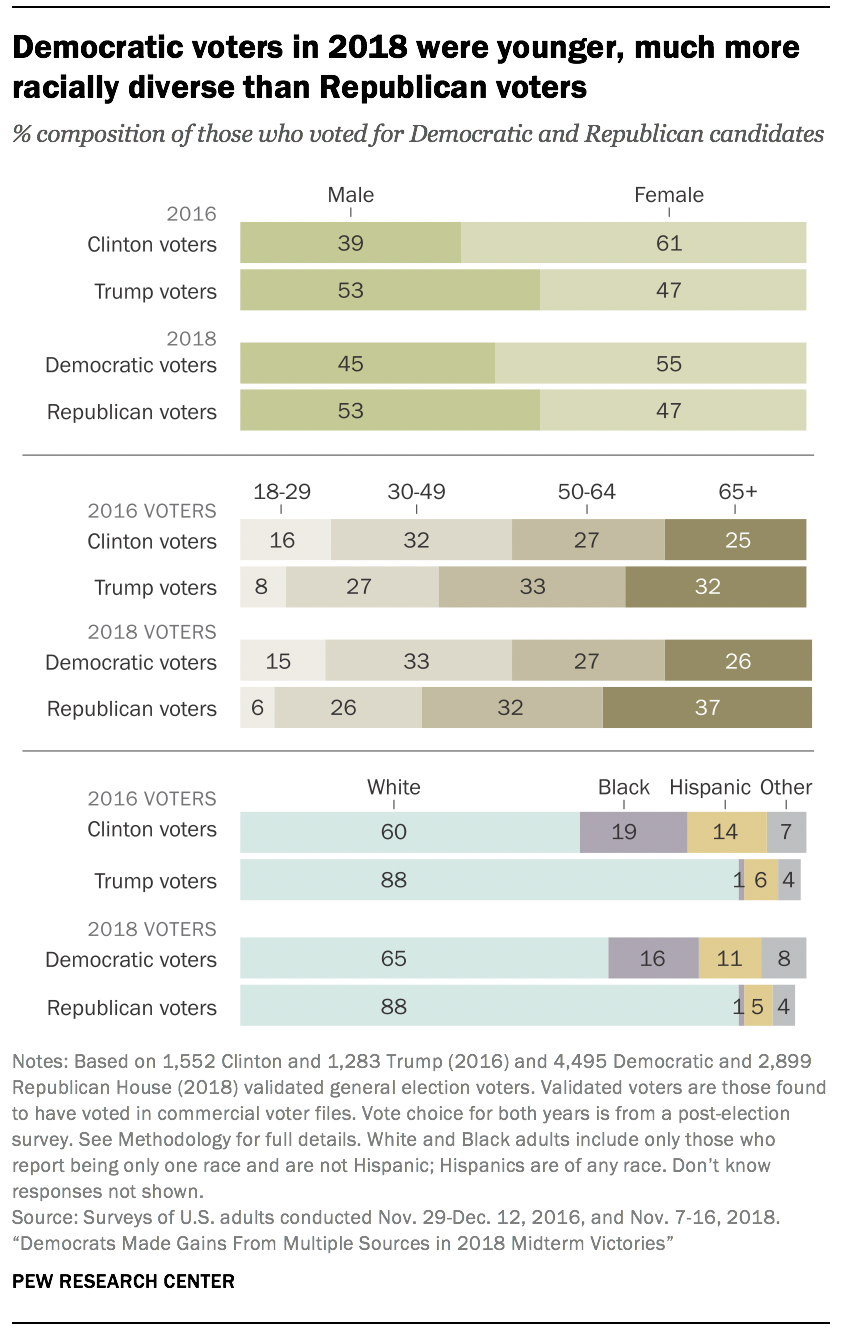 People who voted for Autonomous vs. Republican candidates for the Firm in 2022 were quite different demographically, in means consistent with previous elections including 2016. The Republican coalition is more likely to be older, male, White, somewhat less educated and Protestant or Catholic.
In 2016, men made up only 39% of Hillary Clinton'south voters. This share grew to 45% for Democratic House candidates in 2018. But other than a slight increment in the share of Republican voters ages 65 and older, there was little change in the respective age profiles of the two parties' voters. Well-nigh half of those who voted for Autonomous candidates were under 50 years of age, compared with well-nigh a tertiary (32%) of Republican voters.
Non-Hispanic White adults made upwardly nearly nine-in-ten Republican voters (88%), compared with just two-thirds (65%) of Autonomous voters. Only one% of voters who chose Republican House candidates were Black (16% of Democratic voters were Black). Hispanics were 11% of the Democratic voter coalition, compared with 5% for the Republican coalition.
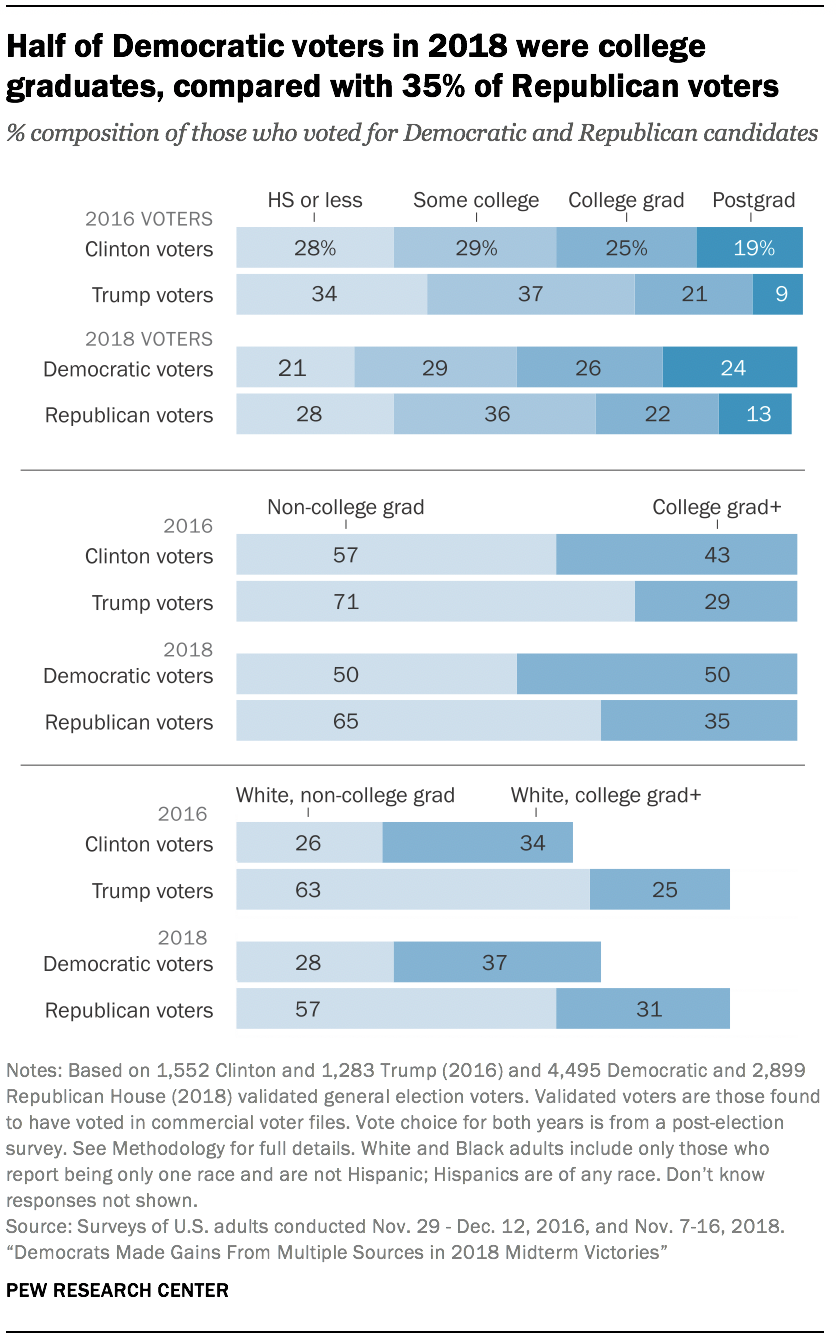 One-half of Democratic voters in 2022 had a four-year college degree or more, compared with 35% of Republican voters. Voters with postgraduate degrees made upwardly virtually a quarter (24%) of the Autonomous electorate, compared with 13% among Republican voters. Combining this with the racial profile of the parties' supporters, 57% of GOP voters were White adults with no college degree, compared with 28% among Autonomous voters.
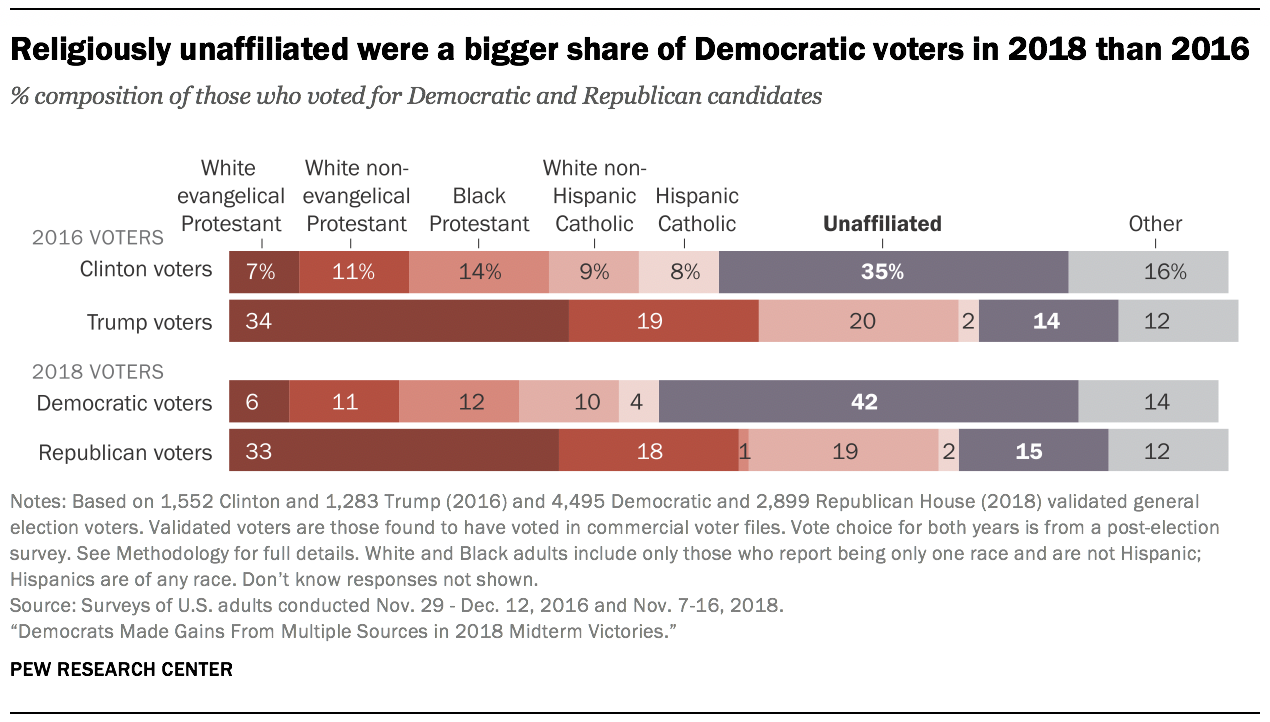
Protestants made up a majority of those voting Republican in 2018, just as they did in 2016. Overall, 57% of GOP House voters were Protestant, compared with just a tertiary (32%) of Autonomous voters. Catholics made up a slightly higher share of Republican voters as well (22% vs. 16% of Democratic voters). Voters who were unaffiliated with any religious tradition (atheists, agnostics and those who depict themselves as "nothing in particular") make up 42% of Democratic voters but just xv% of Republican voters.
The demographic profile of voters and nonvoters is very different
 The roughly half of Americans who voted in 2022 differ from the voting-eligible adult population in some central respects. There were sizeable, if familiar, demographic and political differences in who did and did not plow out.
Compared with citizens who did not vote, voters were older, more likely to be college educated, better off financially, more probable to be White Protestants or Catholics and more Republican in political party affiliation and candidate preference. These differences are regular features of U.Due south. elections, as a comparison with voters and nonvoters in 2022 makes clear.
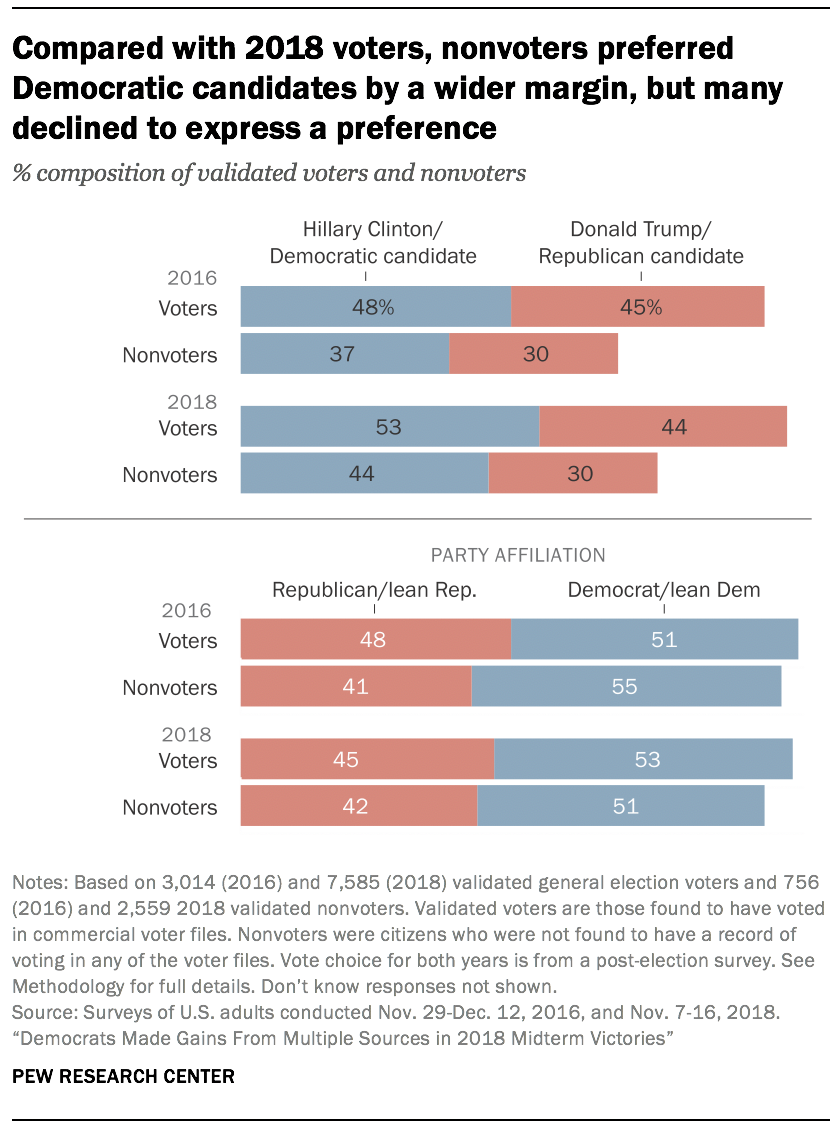 All citizen panelists – whether voters or nonvoters – were asked which U.Due south. House candidate they supported in the general election. Nonvoters tend to express more doubtfulness about the choice, owing in large part to the fact that many of them pay little attention to politics. But among those who did express a preference, Democratic candidates led Republican candidates past 14 pct points (44% to 30%) a larger margin than amongst voters (nine points, 53% to 44%).
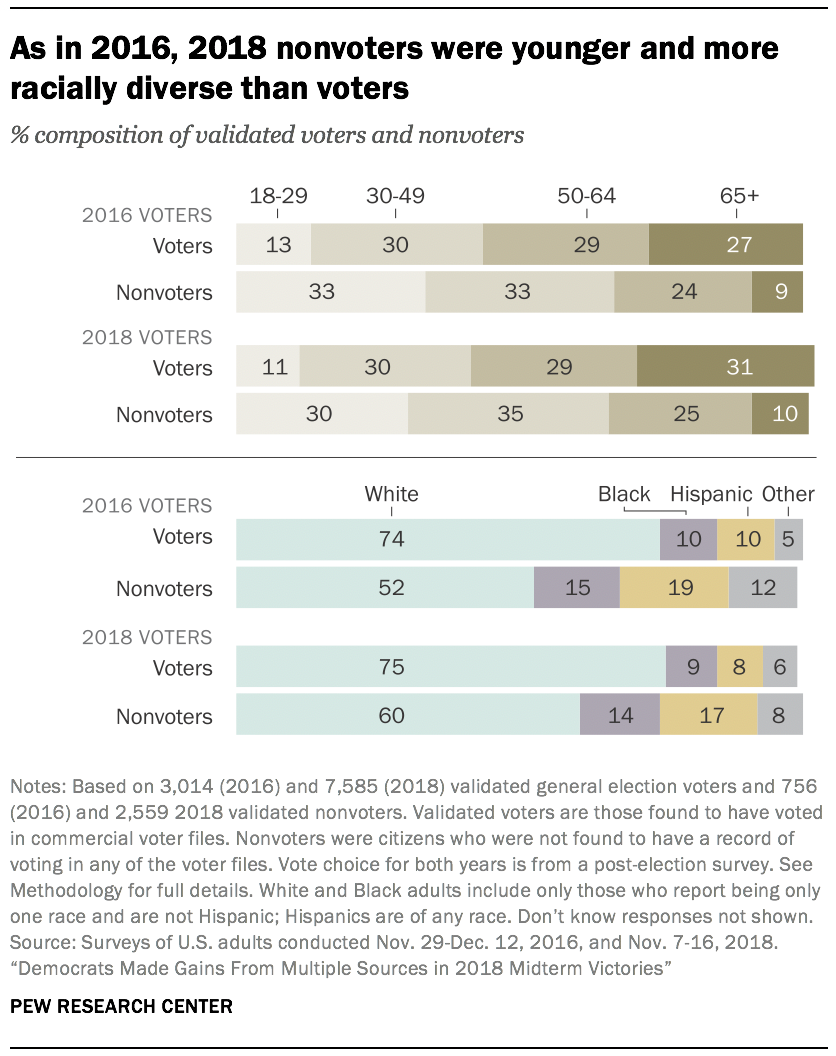
Demographically, the dissimilarity between voters and nonvoters is most stark on age, race, education and income. Voters in 2022 were considerably older than nonvoters: 31% of voters but merely x% of nonvoters were ages 65 and older. At the other cease of the age spectrum, just 11% of voters were under 30 years of age; thirty% of nonvoters savage into this category. These gaps are quite similar to those seen in 2016.
Similarly, iii-quarters of voters (75%) were non-Hispanic White adults, while 60% of nonvoters were White. Hispanics, in particular, were underrepresented as voters. Just 8% of 2022 voters were Hispanic. Among the voting-eligible nonvoters, 17% were Hispanic. Black adults were nine% of voters simply 14% of nonvoters.
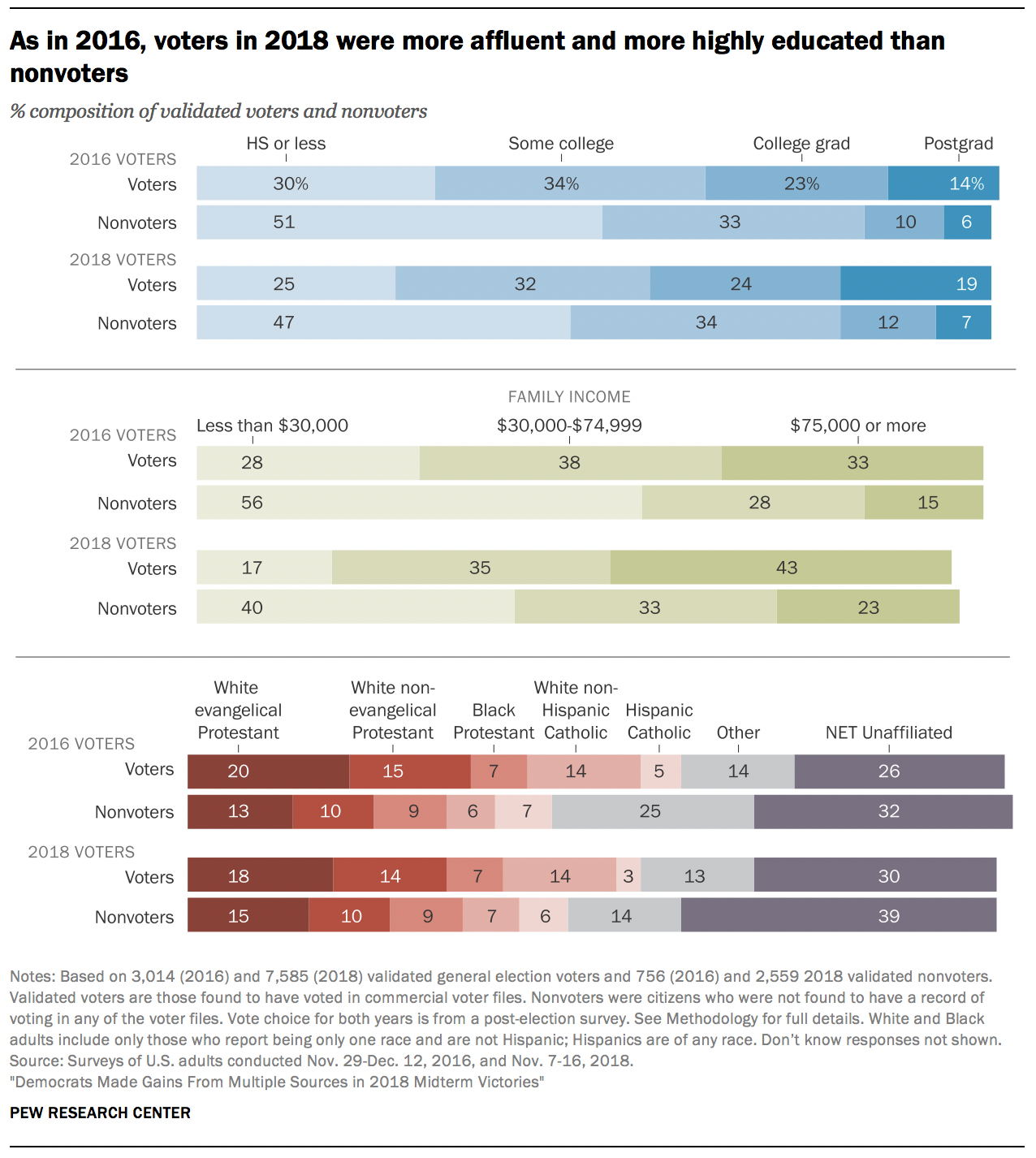
Voters tend to be more than highly educated and more flush than nonvoters. 1-quarter of voters had only a loftier school education, but 47% of nonvoters did so. More than than four-in-ten voters (43%) were college graduates, compared with only nineteen% of nonvoters. The differences past income were similarly substantial. Just 17% of voters had annual family unit incomes of less than $30,000. Amongst nonvoters, 40% did so.
White Protestants and White Catholics brand upwards most half of all voters (46%) but but 32% of nonvoters. People who describe their religious affiliation as "cypher in item" are underrepresented amid voters, constituting 28% of all nonvoters only just 16% of voters.
townsontionampicest.blogspot.com
Source: https://www.pewresearch.org/methods/2020/09/08/democrats-made-gains-from-multiple-sources-in-2018-midterm-victories/
0 Response to "Total Democratic Votes for House of Representatives 2018"
Post a Comment