How to Tenderize a Beef Roast
I own all the latest culinary doodads and gadgets, but all I really demand is my trusty chef's knife and my grandma'south cast iron frying pan.
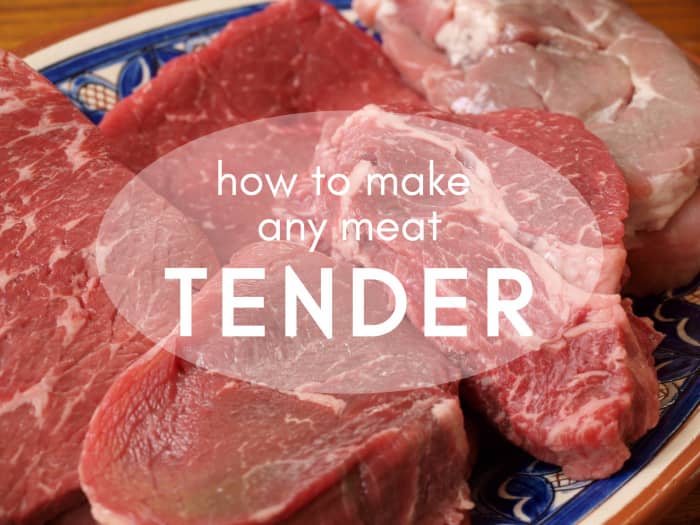
9 Genius Means to Tenderize Any Cut or Kind of Meat
How Can I Make This Steak, Chop, Loin, or Roast More Tender?
Even if I could beget to purchase filet mignon or Wagyu or jamon Iberico every mean solar day, I wouldn't want to. For so many reasons, it's important to use every part of the animal. Besides, I know that some of the least fancy cuts are completely worth the extra time it takes to fix them. My favorite stew is made with the cheapest rump roast I tin can find, but when I'm done with it, it tastes like a one thousand thousand dollars!
Every cook has their ain preferred method for transforming cheap, tough meat into delicious, tender mouthfuls. Here, I've gathered every meat-tenderizing technique in one place. Virtually of these methods work on whatsoever kind of meat: beef, pork, lamb, goat, buffalo, venison, etc., and for each method, I list on which cuts it works best.
Annotation: Many of these methods work on poultry (craven, turkey, etc.), but I'thou mainly focused on meat in this commodity!
8 Surefire Ways to Tenderize Meat (Plus a Controversial One)
- Pound it into submission. Use a mallet or comprehend information technology in saran wrap and thump it with a rolling pin or a heavy skillet.
- Cook It long and low. Both dry heat (similar on a grill), or wet (equally in a braise, stew, or crock pot) will do.
- Use fruit enzymes to suspension upwards the proteins. Run into the list of fruits below.
- Dry out-age it (if y'all have time). This process uses the meat's own enzymes to interruption down the muscle tissue.
- Use a knife to either macerate the raw surface so that information technology absorbs the enzymes/marinade more securely, or piece the cooked meat thinly and against the grain. Either way, you're using a knife to help y'all chew. If you accept a meat grinder, you can turn it into footing meat.
- Use baking soda. This method is not for anybody, but you can't make many Asian meat dishes without knowing how.
- Use salt. Although some scientific discipline-types insist that common salt makes meat drier (and therefore tougher), it has been used as a tenderizer for centuries, and all serious chefs and in-the-know foodies salt their meat earlier cooking.
- Let the cooked meat sit earlier cut. This is the final, crucial stride for all cuts and types of meat.
—The next method is controversial, only definitely worth mentioning:— - Utilise an acidic marinade. Some people swear it helps tenderize the meat, but others argue information technology only adds flavor.
Each of these methods is described fully below.
1. Use Your Muscles
The oldest, easiest, and most obvious way to tenderize meat is to pound information technology into submission. Apply a mallet or encompass it in saran wrap and thump it with a rolling pin or a heavy skillet.
When should I utilize a meat mallet?
This method is best if you plan on frying or sautéeing quickly, but isn't recommended if you want to apply the grill. Since y'all're manually breaking the fibers, the meat volition lose some of its cohesion and integrity.
Which cuts should I use a mallet on?
For obvious reasons, pounding works best on smaller, boneless pieces like cutlets and steaks. Pummeling a roast with a heavy skillet would be dangerous, for you and the roast!
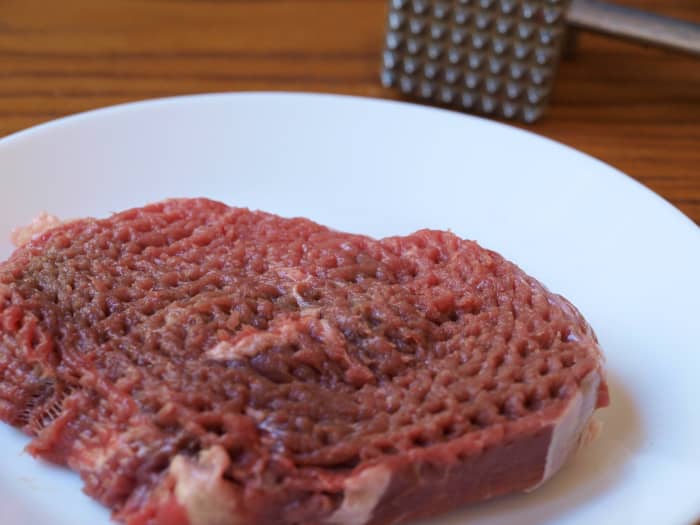
Utilize a meat mallet to break down the tough fibers.
2. Cook It Long and Low
With a little estrus and a lot of fourth dimension, the collagen in the toughest cuts eventually breaks downwards, leaving you with shreds of tender, juicy meat.
How does heat make meat tender?
Meat is made up of long fibers, each individually wrapped in a sheath of collagen, a connective tissue that, when heated besides high, shrinks and squeezes out the juices. That'south why well-washed meat is tougher. But if you keep the heat from 160° to 205°F, the collagen begins to gelatinize and the meat gets more tender.
How low should I get?
Anywhere from 160° to 205°F will work, but 190°F is the sugariness spot.
How long is long enough to melt meat?
Old-school chefs say all day, but I say two and a half hours. J. Kenji Lopez-Alt's article on this topic, Why You Shouldn't Cook Your Beefiness All Twenty-four hours is worth reading.
What method of long, tiresome cooking works best?
You can utilize either dry (grilling or smoking) or wet heat (braising or stewing). You can use a boring-cooker or a dutch oven.
Coil to Go on
Read More than From Delishably
Which cuts have the virtually collagen?
Brisket, rib, beef chuck, shank, short loin, shoulder, or butt. These all answer well to slow cooking, but chops and filets don't.
Food for thought: Overcooking or cooking besides fast volition render a tough piece of meat even tougher. If you're the impatient type, utilise a thermometer.
3. Use Fruit Enzymes
Some fruits contain protease, a kind of enzyme that's great for breaking down meat proteins. These fruits specially:
- kiwi is at the top of the list since it contains actinidin, which works gently and has a neutral season. Some cooks let the meat sit in a kiwi marinade for almost a week.
- pineapple contains bromelain, an enzyme that is so strong it will turn your meat to mush if you're non careful.
- papaya
- Asian pear
- fig
- mango
How much fruit should I employ? Include up to ii tablespoons of the mashed fruit per loving cup of marinade, but be careful not to permit it marinate for besides long or it will turn to mush. If yous happen to have pineapple or mango juice, you can utilize that, likewise.
What temperature works all-time? Fruit enzymes work all-time betwixt 50–seventy°C (120-160°F).
Which cuts work all-time with fruit enzymes? Only like with other marinades, fruit enzymes work all-time on thinner cuts.
What well-nigh a commercial tenderizer? Most pre-packaged tenderizing powers are made with dried fruit enzymes. I prefer to use the whole fruit, but many people swear by them.
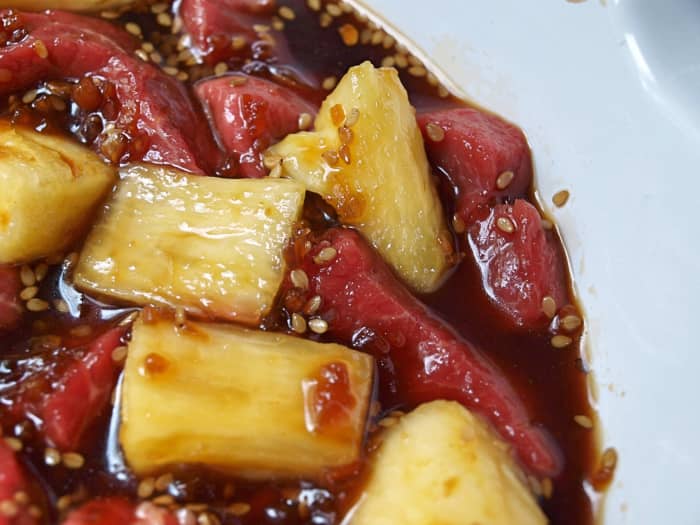
Pineapple is one of the fruits that contain the special enzyme that tenderizes meat.
4. Dry out-Historic period Meat for Tenderness
Dry-aging uses the meat's own enzymes to break muscle fiber down and results in a more than tender and flavorful cut.
How long does it accept to dry-age meat? At that place is some debate about this.
- Some, including Cook's Illustrated, say four days is probably the longest you should adventure in a non-commercial cooling unit. Most recipes for roasting meat in Cook's Illustrated call for crumbling it for 1 to 4 days and they also recommend salting and rubbing information technology with butter.
- But others, including The Food Lab's Complete Guide to Dry-Aging Beefiness at Home, say 14 to 28 days is all-time.
- If you take a large sub-primal cut of meat, nearly concord that a couple weeks of aging is enough. The older you exit information technology, the funkier it will get, simply some people like it funky. I suggest you experiment in your refrigerator to find what works best for you.
Which spot in the refrigerator works best for dry out-aging?
According to America'southward Test Kitchen, the platonic goal for humidity is from 80 to 85% and the ideal temperature is between 33 and 40 degrees. Their team recommends putting the meat at the back-most, bottommost part of the refrigerator (the coldest part). Since near home refrigerators lack the humidity command of commercial ones, they also recommend wrapping the meat in several layers of cheesecloth and placing it on a wire rack. Many chefs recommend placing the meat almost the fan, if possible. The meat should be occasionally turned to assist it age evenly.
What happens when meat is dry-aged?
- It gets significantly more tender.
- The stale or yucky outer layer volition need to exist trimmed.
- You'll lose up to 30% of the cut due to moisture loss and/or trimming.
- It develops a deep, nutty, umami flavor and aroma.
Which meats are ideal for dry-aging?
Beef is commonly aged, of course, but information technology works on pork, also. It is of import that yous start with every bit large a piece as possible, the whole sub-key cutting—the meridian round or whole tenderloin, for example—bone-in, with fat caps intact. If yous can become the butcher to requite information technology to yous before it is cut into smaller steaks, this is ideal. Dry-aging smaller pieces will not be worth your while in terms of tenderness or flavor, and you lot might lose too much to trimming.
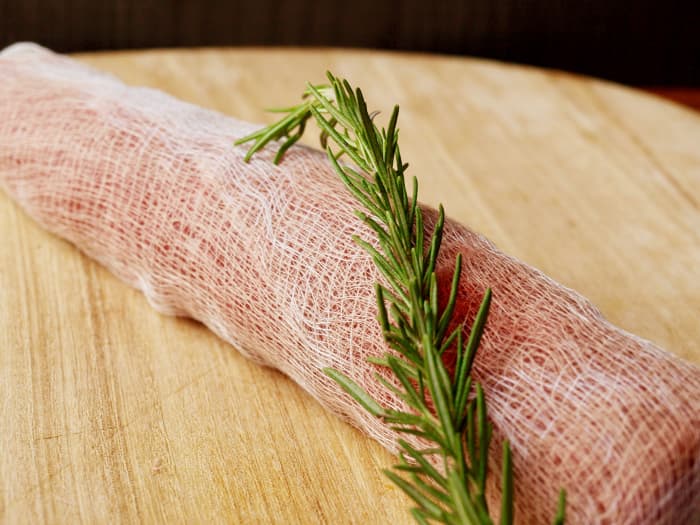
Wrap the cut in cheesecloth before you stick it in the refrigerator to dry age.
five. Let the Knife Practice the Chewing for You
- Cut the connective tissue to brand it more tender. Slice the cooked meat thinly, against the grain. Your knife should bisect the musculus fibers, non follow them. This is peculiarly important for flank and skirt steaks.
- You lot can likewise use your knife to perforate the outer surface of the raw meat before you marinate or salt.
- If you have a meat grinder, you can accept it to the adjacent level by turning tough cuts into tender ground meats.
half-dozen. Use Baking Soda
Cook'due south Illustrated explains how blistering soda alkalizes the surface of the meat, hampering the proteins' bonds and making the meat more than tender. Many people honey this method, but some complain that even after rinsing, a vaguely alkaline gustation remains.
Which meat or cuts work best? Any kinds, simply since it does touch both the taste and the texture of the meat, use only the cheapest, toughest cuts. As well, since it only works on the surface, this method should but be used on the smallest, thinnest, bite-sized pieces.
How should I apply the blistering soda?
- Coat and rub the meat with baking soda past property a tablespoon of it in your manus and sprinkling a thin layer OR dissolve the baking soda in h2o and submerge the meat.
- Let information technology residuum on the counter for xv-20 minutes. If you lot get out it longer, it won't hurt the meat, only it won't make it more tender, either.
- Rinse thoroughly to remove all the baking soda, since it affects texture and taste (only dry the meat thoroughly before y'all melt it if you want it to brown).
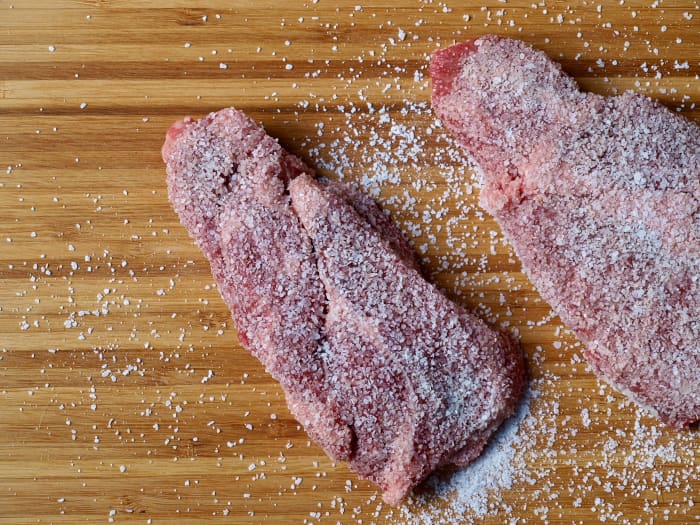
Wash or knock off all the excess salt before cooking.
seven. Use Salt as a Tenderizer
Some science folks insist that table salt makes meat tougher, not tenderer, but the best chefs and true foodies know better. If you lot give it time, salt can boom the poly peptide strands and dissolve the muscle fibers of tough meats.
According to about cookbooks and sources, including Cook'southward Illustrated and America'south Test Kitchen, salt is the hole-and-corner to juicy roasts. Since brining works only for extremely lean cuts, instead they recommend rubbing roasts with table salt and then refrigerating for 24 hours before cooking. For smaller cuts like steaks they say 40 minutes is sufficient. If you're interested in learning more about this topic, Turning Inexpensive "Choice" Steak into Gucci "Prime" is worth reading.
How should I apply the salt?
- Place the meat on a pan, board, or plate and sprinkle its unabridged surface with a generous layer of salt. Turn information technology over and salt the other side, also. You can massage information technology a lilliputian if you lot want to.
- Leave information technology laying there untouched, at room temperature. How long depends on how thick the cutting of meat is. Requite information technology an hour for each inch of thickness. So if yous have a 1 1/ii inch steak, let information technology sit for an hour and a half.
- When the proper amount of time has passed, thoroughly brush or wash off the common salt on the surface of the meat. This footstep is important because you lot don't want to swallow all that salt.
For how long should I salt the meat? Like I said before, let it sit down salted for an hour per inch of thickness.
Which kind of meat should I salt? All kinds and cuts of meat.
What kind of salt works best? Many chefs insist that y'all employ a coarse grain (coarse kosher or body of water salt). They say that the fine grains deliquesce and become absorbed as well quickly and affect the taste. I admit that I sometimes use tabular array salt, but I brush it off before I cook, and the meat tastes fine.
viii. Always Let the Meat Rest Before Cutting It
Don't blitz this final, crucial pace! It's been proven beyond a shadow of a doubt by experts like J. Kenji López-Alt that short rest on the carving lath BEFORE CUTTING makes all the difference. If you lot cut it correct after removing it from the heat, well-nigh 40% more of the meat's juice volition stop up on your cut lath, but if you give it time to rest, relax, and re-absorb all its own juice, your mouth volition definitely find the difference.
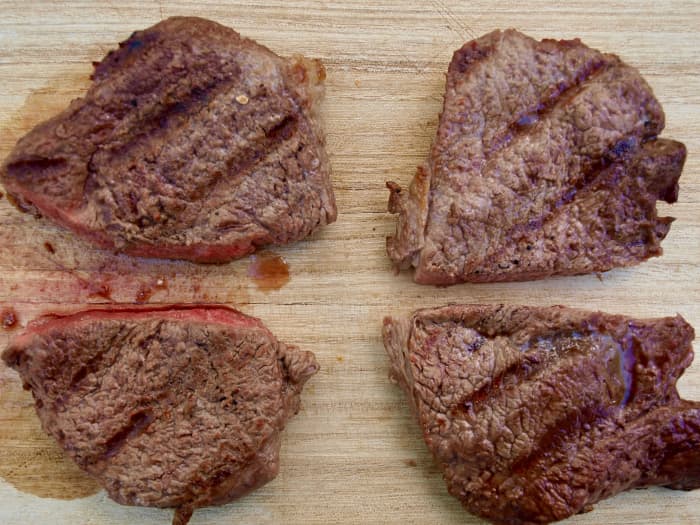
Nosotros prematurely cutting an edge off the meat on the left to prove how much juice tin be lost on the cut board.
9. Employ an Acidic Marinade
Food scientists know that although marinades are dandy for flavor, they don't always work to tenderize. Acids tin can accept some time to penetrate meat, and added oils and sugars might slow the process down, so if you have a thicker cut, a marinade is probably a waste of fourth dimension.
How long should I marinate for best results?
If you just take a couple hours, go for a straight acid mix. If you accept more than time, employ a marinade with oil in it. Brand sure you don't leave it in besides long, since over-marinated meat can get too soft and mushy.
What'south the all-time method for marination?
Place the marinade-submerged meat in a covered basin or resealable bag. Information technology should not exist open up to the air. Allow it sit in the refrigerator from 2 to 24 hours.
Which cuts should be marinated?
Thin pieces of the toughest cuts work best. Flank, skirt, sirloin, round, and hanger steaks, for instance. Don't bother marinating a high quality steak: it doesn't need any aid to arrive tender and tasty, so you'll probably ruin information technology.
Which acids piece of work all-time in a tenderizing marinade?
- vinegar (whatsoever kind, but be aware of its effect on season)
- Worcestershire, tomato, teriyaki, or soy sauce
- wine or beer
- lemon or lime juice
- yogurt or buttermilk
Consider combining these acids with the protease fruits described in #iii above.
Which Cuts of Meat Are the Toughest?
The trick is knowing where that meat came from on the animal. A hardworking, frequently-used muscle (similar on the leg) will by and large be tougher than a seldom-used, depression-activeness musculus (like in the loin). These are the toughest:
- Bottom circular
- Brisket
- Chuck roast
- Heart of round
- Flank steak
- Hanger steak
- Round or rump roast or steak
- Shank
- Brusk ribs
- Skirt steak
- Shoulder roast
- Top round
These might too be tough:
- Chuck steak
- Top blade steak
Hard-working muscles take more collagen, which holds the muscles together and keeps them attached to the bone. It'southward the collagen that makes them tough. But if you apply one or more than of the methods described above, the collagen will transform into gelatin, which gives meat a succulent succulence.
Kitchen Controversies & Oftentimes Asked Questions
Why doesn't anybody employ blistering soda, since it's and then cheap?
Of all the methods I've listed here, blistering soda is the most questionable, since it can make the meat's texture kind of sticky and its season bitter. On the other mitt, when it's washed properly, it can be quite delicious!
What about commercial tenderizers?
Many reputable chefs seem to use them. Although I've never used one, the brand I saw mentioned most in my library of cookbooks was Adolph's Original Tenderizer, which uses pineapple fruit excerpt as an enzyme, plus natural sugars and body of water salt.
But I heard that salt makes meat tough.
I know, I know, information technology doesn't make sense, but the greatest cooks have been using it for centuries, so you'll just have to suspend your atheism and requite information technology a effort.
I call back marinating makes meat tougher, not more tender!
If you leave cooked meat in acid, it can get tough, but if you leave raw meat in a marinade likewise long, the acids can digest the meat and so much information technology's no longer edible.
What exercise you think?
© 2017 Jo Tucker
townsontionampicest.blogspot.com
Source: https://delishably.com/meat-dishes/How-to-Tenderize-Steak-Beef-Other-Meats-Steak-Marinade-Recipes
0 Response to "How to Tenderize a Beef Roast"
Post a Comment