What Liabilities Are Subtracted From Current Assets to Find Net Operating Working Capital?
Finance teams that want to know whether their companies can withstand an unexpected downturn or crisis need a handle on two metrics: working capital and greenbacks flow. These two metrics illustrate different aspects of a company's financial health. While cash flow measures how much money the company generates or consumes in a given menstruation, working uppercase is the difference betwixt the company's current assets — including greenbacks and other assets that can exist converted into greenbacks within a twelvemonth — and its current liabilities, such as payroll, accounts payable and accrued expenses.
A business that maintains positive working majuscule will likely have a greater ability to withstand fiscal challenges and the flexibility to invest in growth afterwards meeting short-term obligations.
What Is Working Capital?
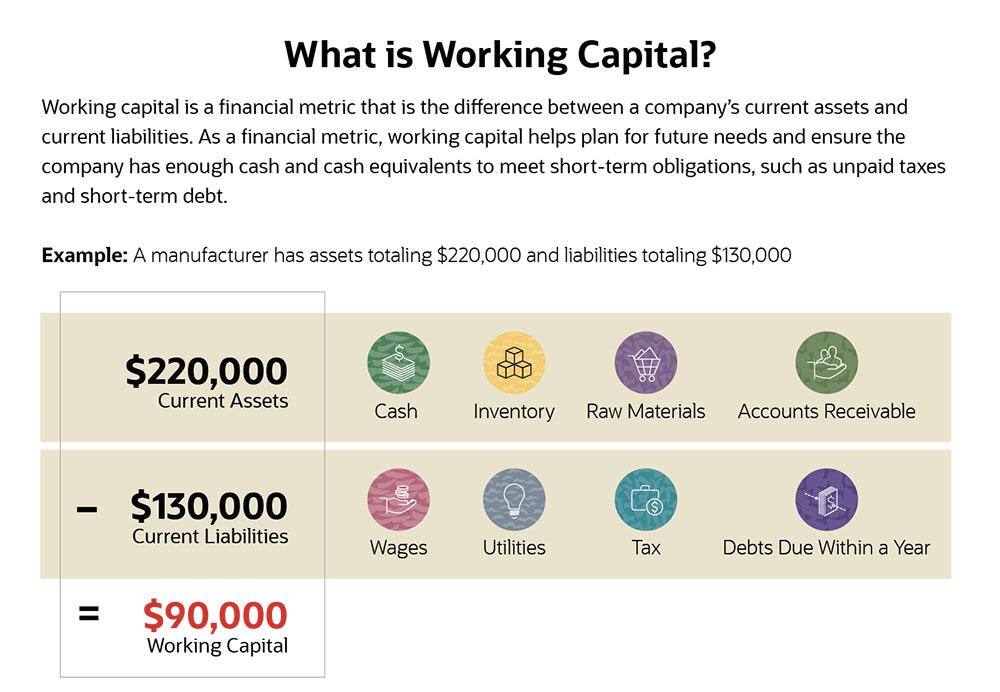
Working capital is calculated by subtracting current liabilities from current assets, equally listed on the company's balance sheet. Current assets include cash, accounts receivable and inventory. Current liabilities include accounts payable, taxes, wages and interest owed.
Key Takeaways
- Working capital is a financial metric calculated every bit the difference between current assets and current liabilities.
- Positive working capital means the visitor can pay its bills and invest to spur business organisation growth.
- Working uppercase management focuses on ensuring the visitor can meet day-to-solar day operating expenses while using its financial resource in the almost productive and efficient way.
Working Capital Explained
This graphic illustrates a typical working upper-case letter calculation.
Why Is Working Capital Important?
Working capital is used to fund operations and meet brusk-term obligations. If a company has plenty working uppercase, it tin proceed to pay its employees and suppliers and meet other obligations, such every bit interest payments and taxes, fifty-fifty if it runs into cash catamenia challenges.
Working uppercase tin as well be used to fund business growth without incurring debt. If the visitor does need to borrow money, demonstrating positive working capital tin go far easier to authorize for loans or other forms of credit.
For finance teams, the goal is twofold: Have a clear view of how much cash is on hand at whatsoever given time, and work with the business to maintain sufficient working capital to cover liabilities, plus some elbowroom for growth and contingencies.
Advantages of Working Majuscule
Working capital can assistance smooth out fluctuations in acquirement. Many businesses experience some seasonality in sales, selling more than during some months than others, for example. With adequate working capital, a company tin can brand actress purchases from suppliers to prepare for busy months while meeting its financial obligations during periods where it generates less revenue.
For example, a retailer may generate 70% of its revenue in Nov and Dec — but it needs to cover expenses, such as rent and payroll, all year. By analyzing its working majuscule needs and maintaining an adequate buffer, the retailer tin can ensure it has enough funds to stock up on supplies before November and hire temps for the busy flavour while planning how many permanent staff information technology can back up.
Working Majuscule and the Balance Sheet
Working capital is calculated from current assets and current liabilities reported on a company's balance sheet. A balance sheet is one of the three principal financial statements that businesses produce; the other two are the income statement and cash flow statement.
The residual canvass is a snapshot of the company's assets, liabilities and shareholders' disinterestedness at a moment in fourth dimension, such equally the end of a quarter or fiscal year. The balance canvass includes all of a visitor's assets and liabilities, both short- and long-term.
The balance sheet lists assets by category in gild of liquidity, starting with greenbacks and cash equivalents. It too lists liabilities by category, with current liabilities start followed by long-term liabilities.
How to Calculate Working Capital
Working capital is calculated as current assets minus current liabilities, equally detailed on the balance sail.
Formula for Working Capital
Working capital = electric current assets – current liabilities
Positive vs Negative Working Capital
A company has positive working capital if it has enough cash, accounts receivable and other liquid avails to cover its short-term obligations, such as accounts payable and curt-term debt.
In contrast, a company has negative working capital if it doesn't have plenty current assets to cover its short-term financial obligations. A company with negative working capital may have trouble paying suppliers and creditors and difficulty raising funds to drive concern growth. If the situation continues, information technology may eventually be forced to shut down.
Elements Included in Working Majuscule
The current assets and liabilities used to calculate working capital typically include the following items:
Current assets
include cash and other liquid avails that can be converted into cash within ane year of the balance canvass appointment, including:
- Cash, including money in depository financial institution accounts and undeposited checks from customers.
- Marketable securities, such as U.S. Treasury bills and money marketplace funds.
- Brusque-term investments a company intends to sell inside one year.
- Accounts receivable, minus any allowances for accounts that are unlikely to be paid.
- Notes receivable — such as short-term loans to customers or suppliers — maturing within ane twelvemonth.
- Other receivables, such equally income tax refunds, greenbacks advances to employees and insurance claims.
- Inventory including raw materials, work in process and finished goods.
- Prepaid expenses, such as insurance premiums.
- Advance payments on future purchases.
Current liabilities
are all liabilities due inside a yr of the balance canvass date, including:
- Accounts payable.
- Notes payable due within one year.
- Wages payable.
- Taxes payable.
- Involvement payable on loans.
- Any loan main that must be paid within a year.
- Other accrued expenses payable.
- Deferred acquirement, such as advance payments from customers for goods or services non nevertheless delivered.
Working Capital Instance
The following working capital case is based on the March 31, 2020, rest sail of aluminum producer Alcoa Corp., every bit listed in its 10-Q SEC filing. All amounts are in millions.
Alcoa listed current assets of $3,333 million, and current liabilities of $ii,223 million. Its working capital was therefore $3,333 1000000 - $2,223 meg = $1,110 million. That represented an increase of $143 meg compared with three months earlier, on Dec. 31, 2019, when the company had $967 1000000 in working uppercase.
| March 31, 2020 | December 31, 2019 | |||||
|---|---|---|---|---|---|---|
| ASSETS | ||||||
| Current avails: | ||||||
| Cash and cash equivalents | $ 829 | $ 879 | ||||
| Receivables from customers | 570 | 546 | ||||
| Other receivables | 95 | 114 | ||||
| Inventories | 1,509 | ane,644 | ||||
| Fair value of derivative instruments | 53 | 59 | ||||
| Prepaid expenses and other electric current assets | 277 | 288 | ||||
| Full current avails | 3,333 | 3,530 | ||||
| Properties, plants, and equipment | 20,181 | 21,715 | ||||
| Less: accumulated depreciation, depletion, and acquittal | 13,021 | 13,799 | ||||
| Properties, plants, and equipment, net | seven,160 | 7,916 | ||||
| Investments | 1,059 | 1,113 | ||||
| Deferred income taxes | 425 | 642 | ||||
| Fair value of derivative instruments | 446 | eighteen | ||||
| Other noncurrent assets | 1,228 | 1,412 | ||||
| Total assets | $ 13,651 | $ xiv,631 | ||||
| LIABILITIES | ||||||
| Electric current liabilities: | ||||||
| Accounts payable, merchandise | $ one,276 | $ i,484 | ||||
| Accrued compensation and retirement costs | 353 | 413 | ||||
| Taxes, including income taxes | 78 | 104 | ||||
| Fair value of derivative instruments | fourscore | 67 | ||||
| Other current liabilities | 435 | 494 | ||||
| Long-term debt due within 1 yr | i | 1 | ||||
| Total current liabilities | 2,223 | 2,563 | ||||
| Long-term debt, less corporeality due within one year | ane,801 | 1,799 | ||||
| Accrued pension benefits | i,455 | one,505 | ||||
| Accrued other postretirement benefits | 729 | 749 | ||||
| Asset retirement obligations | 548 | 606 | ||||
| Environmental remediation | 289 | 296 | ||||
| Fair value of derivative instruments | 164 | 581 | ||||
| Noncurrent income taxes | 299 | 276 | ||||
| Other noncurrent liabilities and deferred credits | 332 | 370 | ||||
| Full liabilities | 7,840 | eight,745 | ||||
How Working Capital Affects Cash Flow
Greenbacks flow is the amount of cash and greenbacks equivalents that moves in and out of the concern during an bookkeeping catamenia. Greenbacks flow is summarized in the company's cash period argument.
A visitor's cash catamenia affects its corporeality of working capital. If revenue declines and the visitor experiences negative cash flow as a upshot, it will depict down its working upper-case letter. Investing in increased production may also result in a decrease in working capital.
Working Uppercase vs Net Working Uppercase
The terms "working capital" and "internet working majuscule" are synonymous: Both refer to the difference between all current assets and all electric current liabilities.
However, some analysts ascertain net working capital more narrowly than working capital.
One of these alternative formulas excludes cash and debt:
Net working capital letter = electric current assets (less cash) - current liabilities (less debt)
An even narrower definition excludes most types of asset, focusing simply on accounts receivable, accounts payable and inventory:
Net working uppercase = accounts receivable + inventory - accounts payable
Working Capital vs. Fixed Assets/Uppercase
Working capital includes only electric current assets, which accept a high degree of liquidity — they tin be converted into cash relatively quickly. Fixed assets are not included in working capital because they are illiquid; that is, they cannot be hands converted to greenbacks.
Stock-still assets include real estate, facilities, equipment and other tangible assets, as well equally intangible assets like patents and trademarks.
What Is Working Uppercase Management?
Working capital management is a fiscal strategy that involves optimizing the use of working upper-case letter to meet mean solar day-to-day operating expenses, while helping ensure the company invests its resources in productive means. Constructive working uppercase management enables the business to fund the cost of operations and pay brusque-term debt.
Several fiscal ratios are commonly used in working capital letter management to appraise the company'southward working capital and related factors.
The working capital ratio, likewise known as the current ratio, is a mensurate of the visitor's power to come across short-term obligations. It'due south calculated equally electric current assets divided past current liabilities.
A working upper-case letter ratio of less than one means a company isn't generating enough greenbacks to pay down the debts due in the coming year. Working capital ratios between ane.2 and 2.0 indicate a visitor is making effective utilise of its avails. Ratios greater than 2.0 indicate the company may not be making the best use of its assets; it is maintaining a large amount of short-term assets instead of reinvesting the funds to generate revenue.
The average collection menstruation measures how efficiently a company manages accounts receivable, which direct affects its working capital. The ratio represents the boilerplate number of days it takes to receive payment after a sale on credit. It's calculated by dividing the average total accounts receivable during a period by the total net credit sales and multiplying the result past the number of days in the menses.
The inventory turnover ratio is an indicator of how efficiently a company manages inventory to run into demand. Tracking this number helps companies ensure they have enough inventory on hand while fugitive tying up too much cash in inventory that sits unsold.
The inventory turnover ratio indicates how many times inventory is sold and replenished during a specific period. It'south calculated as cost of appurtenances sold (COGS) divided past the average value of inventory during the menstruum. A college ratio indicates inventory turns over more oftentimes.
Working Capital: The Quick Ratio and Current Ratio
Analysts and lenders utilise the electric current ratio (working capital letter ratio) as well as a related metric, the quick ratio, to measure a company'due south liquidity and ability to meet its short-term obligations.
These two ratios are also used to compare a business'due south current functioning with prior quarters and to compare the business organization with other companies, making it useful for lenders and investors.
The quick ratio differs from the current ratio by including only the company'southward almost liquid assets — the assets that it tin can quickly plow into greenbacks. These are cash and equivalents, marketable securities and accounts receivable. In contrast, the current ratio includes all current avails, including assets that may not be easy to convert into cash, such as inventory.
Because of this, the quick ratio tin exist a better indicator of the company's ability to raise cash speedily when needed.
Does Working Capital Change?
For almost companies, working capital constantly fluctuates; the remainder sheet captures a snapshot of its value on a specific date. Many factors can influence the amount of working capital, including big outgoing payments and seasonal fluctuations in sales.
6 Ways to Increase Working Capital
A business concern may wish to increment its working capital letter if it, for example, needs to comprehend project-related expenses or experiences a temporary drop in sales. Tactics to span that gap involve either adding to current assets or reducing electric current liabilities.
Options include:
- Taking on long-term debt. This increases current assets by calculation to the company'southward available cash only doesn't overly increase current liabilities.
- Refinancing short-term debt as longer-term debt. This reduces current liabilities considering the debts are no longer due inside a year.
- Selling illiquid assets for cash, thus increasing current assets.
- Analyzing and reducing expenses, reducing current liabilities.
- Analyze and optimize inventory management to reduce overstocking and the likelihood that inventory will need to be written off.
- Automate accounts receivable and payment monitoring. This can increase cash menstruum, reducing the need to draw on working upper-case letter for day-to-day operations.
Complimentary Working Uppercase Template
To go started calculating your visitor's working capital, download our free working capital template.
Get the template
Managing working capital with accounting software is important for your company's health. Positive working capital means you lot accept enough liquid assets to invest in growth while meeting brusk-term obligations, like paying suppliers and making interest payments on loans. In dissimilarity, negative working capital is a alarm sign that a company may have difficulty keeping its head above h2o — and an ERP with strong compliance management improves business performance and increases financial close efficiency while reducing back-office costs, resolving delays and generating statements and disclosures that comply with regulatory requirements.
townsontionampicest.blogspot.com
Source: https://www.netsuite.com/portal/resource/articles/financial-management/working-capital.shtml
0 Response to "What Liabilities Are Subtracted From Current Assets to Find Net Operating Working Capital?"
Post a Comment