What Volume Is Required to Provide a Profit of 1,000,000
Cost-Volume-Profit Assay
12 Explain Contribution Margin and Summate Contribution Margin per Unit, Contribution Margin Ratio, and Full Contribution Margin
Before examining contribution margins, let'south review some key concepts: fixed costs, relevant range, variable costs, and contribution margin. Fixed costs are those costs that will not change within a given range of production. For example, in the electric current case, the fixed costs will be the educatee sales fee of $100. No matter how many shirts the club produces within the relevant range, the fee volition be locked in at $100. The relevant range is the anticipated production activeness level. Fixed costs remain constant inside a relevant range. If production levels exceed expectations, and so boosted fixed costs will be required.
For example, presume that the students are going to lease vans from their university'due south motor pool to drive to their conference. A university van volition concur eight passengers, at a price of $200 per van. If they transport one to viii participants, the fixed cost for the van would be $200. If they send nine to sixteen students, the fixed toll would exist $400 because they will need two vans. We would consider the relevant range to be between one and viii passengers, and the fixed cost in this range would be $200. If they exceed the initial relevant range, the fixed costs would increment to $400 for nine to sixteen passengers.
Variable costs are those costs that vary per unit of measurement of product. Direct materials are frequently typical variable costs, considering you normally use more direct materials when y'all produce more items. In our case, if the students sold 100 shirts, assuming an individual variable cost per shirt of $ten, the total variable costs would be $1,000 (100 × $x). If they sold 250 shirts, again assuming an individual variable cost per shirt of $ten, then the full variable costs would $2,500 (250 × $ten).
Contribution margin is the amount by which a product'south selling price exceeds its total variable toll per unit. This difference between the sales price and the per unit variable toll is called the contribution margin because information technology is the per unit contribution toward covering the stock-still costs. Information technology typically is calculated past comparing the sales revenue generated by the sale of one particular versus the variable cost of the item:

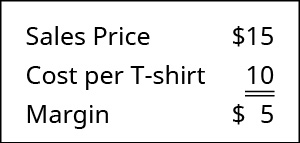
In our example, the sales acquirement from one shirt is $15 and the variable price of i shirt is $10, so the individual contribution margin is $five. This $5 contribution margin is assumed to commencement cover fixed costs first and and then realized every bit profit.
Equally you volition encounter, it is non only small operations, such as the accounting club scenario provided in Why Information technology Matters, that benefit from toll-volume-profit (CVP) assay. At some betoken, all businesses notice themselves asking the same basic questions: How many units must be sold in order to reach a desired income level? How much will each unit cost? How much of the sales price from each unit will assistance cover our fixed costs? For case, Starbucks faces these same questions every day, only on a larger scale. When they innovate new menu items, such every bit seasonal specialty drinks, they must determine the fixed and variable costs associated with each particular. Adding menu items may not simply increment their stock-still costs in the curt run (via advertising and promotions) only will bring new variable costs. Starbucks needs to toll these drinks in a way that covers the variable costs per unit and additional fixed costs and contributes to overall net income. Regardless of how large or small the enterprise, understanding how fixed costs, variable costs, and volume are related to income is vital for audio controlling.
Starbucks. Large corporations similar Starbucks use toll-book-turn a profit assay to make decisions about their products and services to ensure that they are maximizing their revenues. (credit: modification of "StarbucksVaughanMills" by "Raysonho"/Wikimedia Commons, CC0)

Understanding how to use fixed costs, variable costs, and sales in CVP analyses requires an agreement of the term margin. You may have heard that restaurants and grocery stores have very low margins, while jewelry stores and furniture stores accept very high margins. What does "margin" mean? In the broadest terms, margin is the difference between a product or service's selling price and its cost of production. Recall the accounting club's T-shirt sale. The departure betwixt the sales price per T-shirt and the purchase price of the T-shirts was the accounting club's margin:
Recall that Building Blocks of Managerial Accounting explained the characteristics of fixed and variable costs and introduced the basics of cost behavior. Allow's at present apply these behaviors to the concept of contribution margin. The company will use this "margin" to cover stock-still expenses and hopefully to provide a profit. Allow'due south begin by examining contribution margin on a per unit basis.
Unit Contribution Margin
When the contribution margin is calculated on a per unit ground, information technology is referred to as the contribution margin per unit or unit contribution margin. Y'all tin find the contribution margin per unit of measurement using the equation shown in (Figure).

It is important to annotation that this unit contribution margin can exist calculated either in dollars or equally a percentage. To demonstrate this principle, let's consider the costs and revenues of Hicks Manufacturing, a small company that manufactures and sells birdbaths to specialty retailers.
Hicks Manufacturing sells its Blueish Jay Model for $1100 and incurs variable costs of $20 per unit. In gild to calculate their per unit contribution margin, we use the formula in (Figure) to determine that on a per unit ground, their contribution margin is:
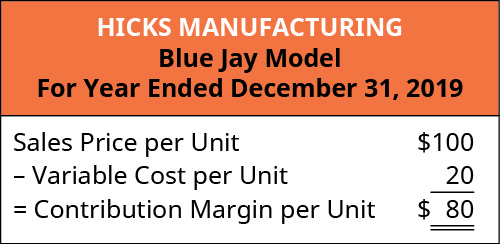
This means that for every Bluish Jay model they sell, they will have $80 to contribute toward roofing stock-still costs, such as rent, insurance, and manager salaries. Just Hicks Manufacturing manufactures and sells more than one model of birdbath. They as well sell a Cardinal Model for $75, and these birdbaths incur variable costs of $15 per unit. For the Cardinal Model, their contribution margin on a per unit basis is the $75 sales price less the $15 per unit variable costs is every bit follows:
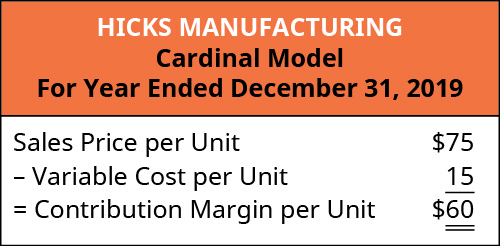
This demonstrates that, for every Cardinal model they sell, they will have $60 to contribute toward covering fixed costs and, if there is any left, toward profit. Every product that a visitor manufactures or every service a company provides will have a unique contribution margin per unit. In these examples, the contribution margin per unit of measurement was calculated in dollars per unit, but another mode to calculate contribution margin is as a ratio (percentage).
Contribution Margin Ratio
The contribution margin ratio is the percentage of a unit'south selling toll that exceeds full unit variable costs. In other words, contribution margin is expressed as a per centum of sales price and is calculated using this formula:

For Hicks Manufacturing and their Blue Jay Model, the contribution margin ratio will be

At a contribution margin ratio of 80%, approximately $0.lxxx of each sales dollar generated by the auction of a Blueish Jay Model is bachelor to embrace fixed expenses and contribute to turn a profit. The contribution margin ratio for the birdbath implies that, for every $ane generated by the sale of a Blue Jay Model, they take $0.eighty that contributes to fixed costs and profit. Thus, 20% of each sales dollar represents the variable price of the particular and 80% of the sales dollar is margin. Merely as each production or service has its own contribution margin on a per unit basis, each has a unique contribution margin ratio. Although this procedure is extremely useful for analyzing the profitability of a single product, good, or service, managers likewise demand to see the "big motion picture" and will examine contribution margin in total across all products, goods, or services.
Margin at the Kiosk
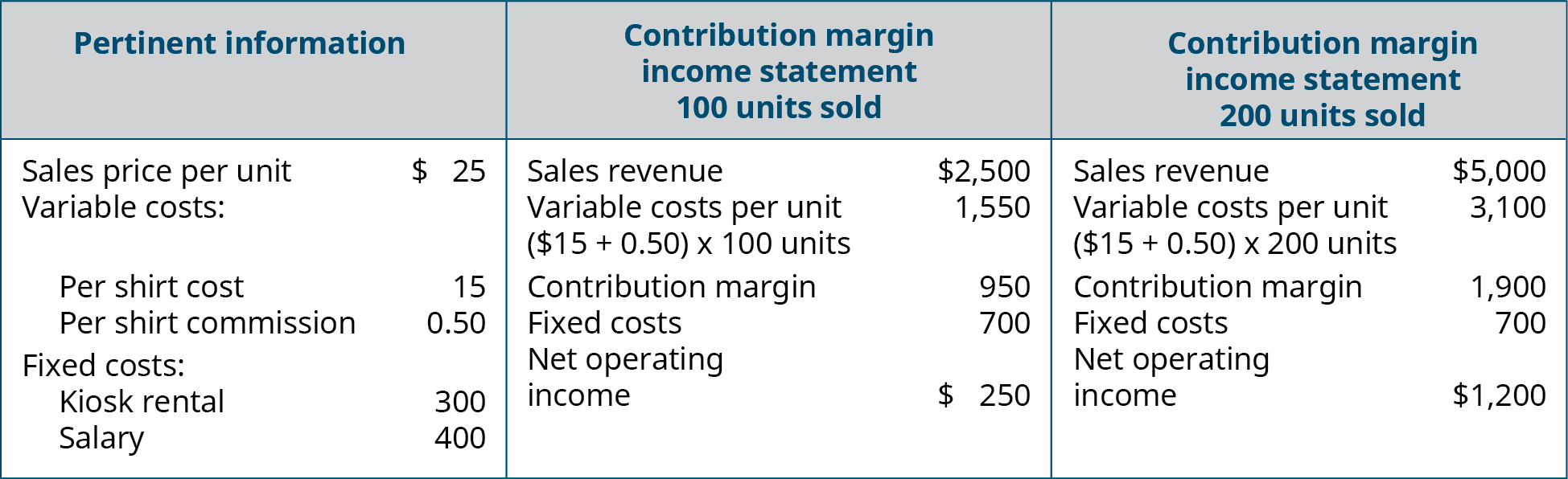
You lot rent a kiosk in the mall for $300 a month and use information technology to sell T-shirts with higher logos from colleges and universities all over the earth. Yous sell each T-shirt for $25, and your cost for each shirt is $15. Y'all also pay your sales person a commission of $0.50 per T-shirt sold in addition to a bacon of $400 per month. Construct a contribution margin income argument for two different months: in one month, assume 100 T-shirts are sold, and in the other, assume 200 T-shirts are sold.
Solution
Total Contribution Margin
This "big pic" is gained by calculating total contribution margin—the total corporeality by which total sales exceed total variable costs. We summate total contribution margin by multiplying per unit contribution margin by sales volume or number of units sold. This arroyo allows managers to determine how much profit a company is making before paying its fixed expenses. For Hicks Manufacturing, if the managers want to determine how much their Blueish Jay Model contributes to the overall profitability of the visitor, they tin summate full contribution margin every bit follows:
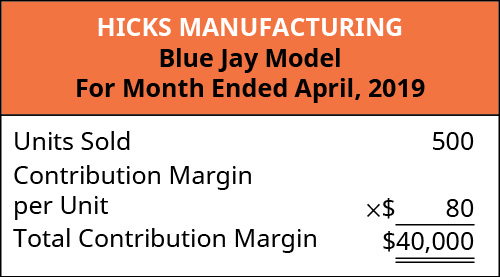
For the month of April, sales from the Blueish Jay Model contributed $36,000 toward fixed costs. Looking at contribution margin in total allows managers to evaluate whether a particular product is assisting and how the sales revenue from that production contributes to the overall profitability of the company. In fact, we can create a specialized income statement called a contribution margin income statement to decide how changes in sales book impact the bottom line.
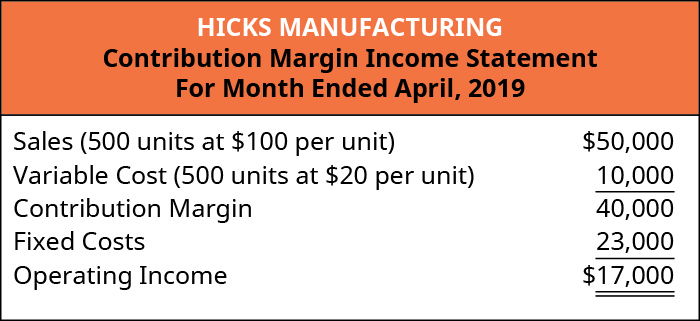
To illustrate how this form of income statement can exist used, contribution margin income statements for Hicks Manufacturing are shown for the months of April and May.
In April, Hicks sold 500 Blue Jay Models at $100 per unit of measurement, which resulted in the operating income shown on the contribution margin income argument:
In May, 750 of the Blue Jay models were sold equally shown on the contribution margin income argument. When comparison the two statements, have annotation of what inverse and what remained the same from Apr to May.
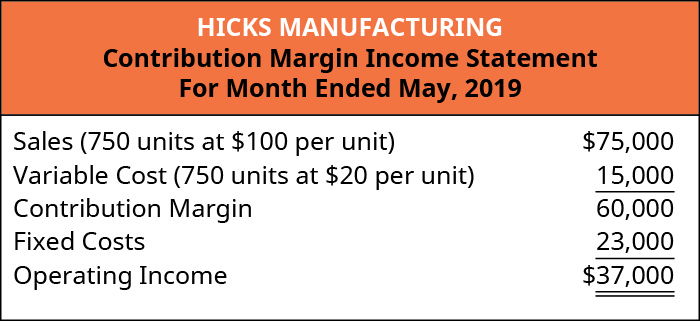
Using this contribution margin format makes it easy to see the impact of changing sales volume on operating income. Fixed costs remained unchanged; even so, every bit more than units are produced and sold, more of the per-unit sales toll is available to contribute to the visitor's cyberspace income.
Earlier going further, let's note several key points well-nigh CVP and the contribution margin income statement. First, the contribution margin income statement is used for internal purposes and is not shared with external stakeholders. Secondly, in this specialized income statement, when "operating income" is shown, information technology really refers to "internet operating income" without regard to income taxes. Companies can too consider taxes when performing a CVP analysis to project both internet operating income and cyberspace income. (The preparation of contribution margin income statements with regard to taxes is covered in advanced accounting courses; here, we will consider cyberspace income every bit net operating income without regard to taxes.)
Regardless of whether contribution margin is calculated on a per-unit ground, calculated as a ratio, or incorporated into an income argument, all 3 express how much sales revenue is available to cover fixed expenses and contribute to profit. Let's examine how all 3 approaches convey the same financial performance, although represented somewhat differently.
Y'all volition call back that the per-unit contribution margin was $80 for a Hicks Blue Jay birdbath. When Hicks sold 500 units, each unit contributed $80 to fixed expenses and profit, which can be verified from Apr'south income argument:
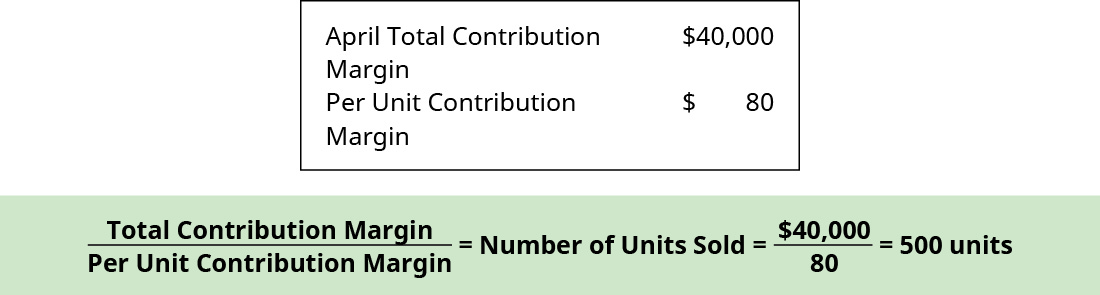
Now, allow's use May's Contribution Margin Income Argument equally previously calculated to verify the contribution margin based on the contribution margin ratio previously calculated, which was 80%, by applying this formula:
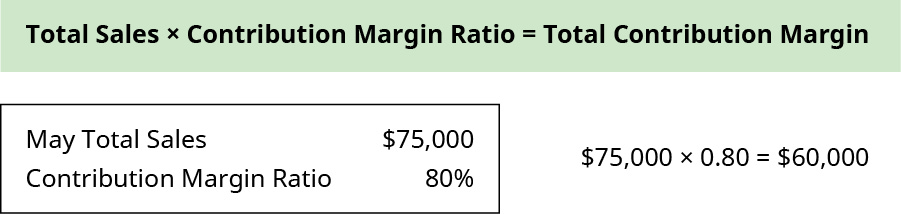
Regardless of how contribution margin is expressed, it provides critical information for managers. Understanding how each product, good, or service contributes to the organisation's profitability allows managers to make decisions such equally which product lines they should aggrandize or which might be discontinued. When allocating scarce resources, the contribution margin will help them focus on those products or services with the highest margin, thereby maximizing profits.
The Evolution of Toll-Book-Profit Relationships
The CVP relationships of many organizations accept become more circuitous recently because many labor-intensive jobs have been replaced past or supplemented with technology, changing both stock-still and variable costs. For those organizations that are withal labor-intensive, the labor costs tend to be variable costs, since at higher levels of activeness there will exist a demand for more labor usage. For example, bold i worker is needed for every 50 customers per 60 minutes, we might demand two workers for an average sales season, but during the Thanksgiving and Christmas season, the store might experience 250 customers per hour and thus would need v workers.
However, the growing tendency in many segments of the economy is to catechumen labor-intensive enterprises (primarily variable costs) to operations heavily dependent on equipment or engineering (primarily fixed costs). For instance, in retail, many functions that were previously performed by people are now performed by machines or software, such every bit the self-checkout counters in stores such as Walmart, Costco, and Lowe's. Since machine and software costs are ofttimes depreciated or amortized, these costs tend to be the same or fixed, no matter the level of action within a given relevant range.
In Communist china, completely unmanned grocery stores have been created that use facial recognition for accessing the shop. Patrons volition store, handbag the purchased items, get out the store, and exist billed based on what they put in their numberless. Along with managing the purchasing process, inventory is maintained by sensors that permit managers know when they need to restock an item.
In the United States, like labor-saving processes take been developed, such as the ability to social club groceries or fast food online and take it ready when the client arrives. Another major innovation affecting labor costs is the development of driverless cars and trucks (primarily fixed costs), which volition have a major impact on the number of taxi and truck drivers in the futurity (primarily variable costs). Do these labor-saving processes modify the cost structure for the company? Are variable costs decreased? What almost fixed costs? Let's await at this in more than detail.
When ordering food through an app, in that location is no need to have an employee take the society, but someone still needs to gear up the food and packet it for the customer. The variable costs associated with the wages of order takers will probable decrease, only the fixed costs associated with boosted technology to allow for online ordering will likely increase. When grocery customers identify their orders online, this not only requires increased fixed costs for the new technology, but it can likewise increase variable labor costs, equally employees are needed to make full customers' online orders. Many stores may move cashier positions to online gild fulfillment rather than hiring additional employees. Other stores may accept employees fill online grocery orders during slow or downtimes.
Using driverless cars and trucks decreases the variable costs tied to the wages of the drivers but requires a major investment in fixed-cost assets—the democratic vehicles—and companies would need to charge prices that allowed them to compensate their expensive investments in the applied science as well as make a profit. Alternatively, companies that rely on shipping and delivery companies that apply driverless applied science may be faced with an increment in transportation or shipping costs (variable costs). These costs may be higher because technology is oftentimes more expensive when it is new than information technology volition be in the future, when it is easier and more toll constructive to produce and also more accessible. A practiced example of the alter in cost of a new technological innovation over time is the personal computer, which was very expensive when it was starting time developed only has decreased in toll significantly since that time. The same will likely happen over time with the price of creating and using driverless transportation.
You might wonder why a company would trade variable costs for fixed costs. One reason might exist to meet company goals, such equally gaining market share. Other reasons include beingness a leader in the employ of innovation and improving efficiencies. If a company uses the latest technology, such as online ordering and delivery, this may help the visitor attract a new type of client or create loyalty with longstanding customers. In addition, although fixed costs are riskier because they exist regardless of the sales level, once those fixed costs are met, profits grow. All of these new trends issue in changes in the composition of fixed and variable costs for a company and information technology is this composition that helps determine a company's profit.
As you will learn in future capacity, in guild for businesses to remain profitable, it is important for managers to understand how to measure and manage fixed and variable costs for decision-making. In this chapter, we brainstorm examining the relationship among sales volume, fixed costs, variable costs, and profit in controlling. We volition hash out how to employ the concepts of fixed and variable costs and their human relationship to profit to make up one's mind the sales needed to break even or to attain a desired profit. You will likewise larn how to plan for changes in selling cost or costs, whether a single production, multiple products, or services are involved.
Deciding Between Orders
Y'all are evaluating orders from two new customers, but you lot will only exist able to take ane of the orders without increasing your fixed costs. Management has directed yous to choose the 1 that is most assisting for the company. Client A is ordering 500 units and is willing to pay $200 per unit, and these units take a contribution margin of $60 per unit. Customer B is ordering i,000 units and is willing to pay $140 per unit, and these units have a contribution margin ratio of 40%. Which order do y'all select and why?
Cardinal Concepts and Summary
- Contribution margin can be used to summate how much of every dollar in sales is available to cover fixed expenses and contribute to turn a profit.
- Contribution margin tin can be expressed on a per-unit basis, as a ratio, or in total.
- A specialized income argument, the Contribution Margin Income Statement, can be useful in looking at total sales and total contribution margin at varying levels of activity.
(Figure)The amount of a unit of measurement'southward sales cost that helps to embrace fixed expenses is its ________.
- contribution margin
- turn a profit
- variable cost
- stepped cost
(Effigy)A visitor's product sells for $150 and has variable costs of $60 associated with the product. What is its contribution margin per unit?
- $twoscore
- $60
- $90
- $150
(Figure)A company'due south product sells for $150 and has variable costs of $60 associated with the production. What is its contribution margin ratio?
- 10%
- twoscore%
- 60%
- 90%
(Figure)A company's contribution margin per unit is $25. If the company increases its activity level from 200 units to 350 units, how much will its total contribution margin increase?
- $1,250
- $iii,750
- $five,000
- $8,750
(Effigy)Define and explain contribution margin on a per unit basis.
Answers will vary. Responses should include that per-unit contribution margin is the amount by which a production's selling toll exceeds it total variable toll per unit.
(Figure)Define and explain contribution margin ratio.
(Figure)Explain how a contribution margin income statement tin can exist used to decide profitability.
Answers will vary. Responses should include that contribution income statements express total contribution margin for a given level of action and can be useful in making decisions about product pricing and optimal levels of action.
(Figure)Calculate the per-unit contribution margin of a product that has a sale toll of $200 if the variable costs per unit are $65.
(Figure)Calculate the per-unit contribution margin of a production that has a sale cost of $400 if the variable costs per unit are $165.
(Effigy)A product has a sales price of $150 and a per-unit contribution margin of $50. What is the contribution margin ratio?
(Effigy)A product has a sales price of $250 and a per-unit contribution margin of $75. What is the contribution margin ratio?
(Effigy)Calculate the per-unit contribution margin of a product that has a sale toll of $150 if the variable costs per unit are $40.
(Figure)Calculate the per-unit contribution margin of a production that has a sale toll of $350 if the variable costs per unit of measurement are $95.
(Figure)A product has a sales price of $175 and a per-unit contribution margin of $75. What is the contribution margin ratio?
(Figure)A production has a sales price of $90 and a per-unit contribution margin of $30. What is the contribution margin ratio?
(Effigy)A visitor sells small motors as a component office to automobiles. The Model 101 motor sells for $850 and has per-unit variable costs of $400 associated with its production. The visitor has fixed expenses of $90,000 per month. In Baronial, the visitor sold 425 of the Model 101 motors.
- Calculate the contribution margin per unit for the Model 101.
- Calculate the contribution margin ratio of the Model 101.
- Prepare a contribution margin income statement for the month of August.
(Effigy)A company articles and sells racing bicycles to specialty retailers. The Bomber model sells for $450 and has per-unit variable costs of $200 associated with its production. The visitor has fixed expenses of $40,000 per month. In May, the company sold 225 of the Bomber model bikes.
- Summate the contribution margin per unit of measurement for the Bomber.
- Calculate the contribution margin ratio of the Bomber.
- Prepare a contribution margin income statement for the month of May.
(Figure)A company sells mulch by the cubic yard. Grade A much sells for $150 per cubic yard and has variable costs of $65 per cubic thou. The visitor has stock-still expenses of $xv,000 per month. In Baronial, the company sold 240 cubic yards of Class A mulch.
- Summate the contribution margin per unit for Grade A mulch.
- Summate the contribution margin ratio of the Grade A mulch.
- Prepare a contribution margin income statement for the month of August.
(Effigy)A visitor manufactures and sells blades that are used in riding lawnmowers. The 18-inch bract sells for $15 and has per-unit variable costs of $4 associated with its production. The company has fixed expenses of $85,000 per month. In January, the visitor sold 12,000 of the 18-inch blades.
- Summate the contribution margin per unit for the 18-inch blade.
- Calculate the contribution margin ratio of the 18-inch blade.
- Prepare a contribution margin income statement for the month of January.
(Figure)Mariana Manufacturing and Bellow Brothers compete in the aforementioned manufacture and in all respects their products are near identical. Yet, most of Mariana'south costs are stock-still while Bellow's costs are primarily variable. If sales increase for both companies, which volition realize the greatest increase in profits? Why?
Glossary
- contribution margin ratio
- percentage of a unit's selling price that exceeds total unit variable costs
- contribution margin
- amount by which a product's selling price exceeds its total variable cost per unit
- relevant range
- quantitative range of units that tin can exist produced based on the visitor's current productive assets; for instance, if a visitor has sufficient fixed assets to produce up to 10,000 units of production, the relevant range would be between 0 and 10,000 units
- total contribution margin
- amount past which total sales exceed full variable costs
townsontionampicest.blogspot.com
Source: https://opentextbc.ca/principlesofaccountingv2openstax/chapter/explain-contribution-margin-and-calculate-contribution-margin-per-unit-contribution-margin-ratio-and-total-contribution-margin/
0 Response to "What Volume Is Required to Provide a Profit of 1,000,000"
Post a Comment